If you follow the news even a little, you have heard the word “inflation” many times. But what does it actually mean for you, your savings, and your trading or investment decisions?
In this article, I will explain the inflation rate in India in simple language. I will cover how it is measured, how it has moved over the last 10 years, where it stands in 2026, and what it could mean for the years ahead. I will also talk about why traders and investors track this number so closely.
I am Shipon, and I write about Indian markets and trading in plain, practical English. This article is for information only. It is not investment advice.
Table of Contents
What Is Inflation, in Simple Words
Inflation is the rate at which prices of goods and services go up over time. When inflation is high, your money buys less than before. A ₹100 note that could buy a certain basket of groceries last year may buy less of the same basket this year, if inflation is high.
A little bit of inflation is normal and even healthy for a growing economy. Problems start when inflation rises too fast, because it eats into people’s savings and pushes up the cost of living.
How Is Inflation Rate in India Measured
In India, the most commonly used measure of inflation is the Consumer Price Index, or CPI. This is published every month by the Ministry of Statistics and Programme Implementation (MoSPI), which is a government body.
CPI tracks the prices of a fixed basket of goods and services that an average household buys. This basket includes:
- Food and beverages
- Housing
- Clothing and footwear
- Fuel and light
- Transport and communication
- Health, education, and other miscellaneous items
The CPI base year was recently updated to 2024, meaning prices are now compared against the price levels of 2024. When you hear a figure like “inflation rate in India is X%,” it usually means prices this month are X% higher than the same month a year ago (year-on-year, or YoY).
There is also a separate measure called the Consumer Food Price Index (CFPI), which focuses only on food items. Since food makes up a large part of an average Indian household’s budget, food inflation often moves the overall CPI number quite a bit.
The Reserve Bank of India (RBI) also tracks Wholesale Price Index (WPI), but CPI is the number that matters most for monetary policy and everyday cost-of-living discussions.

Inflation Rate in India: Recent Trend in 2026
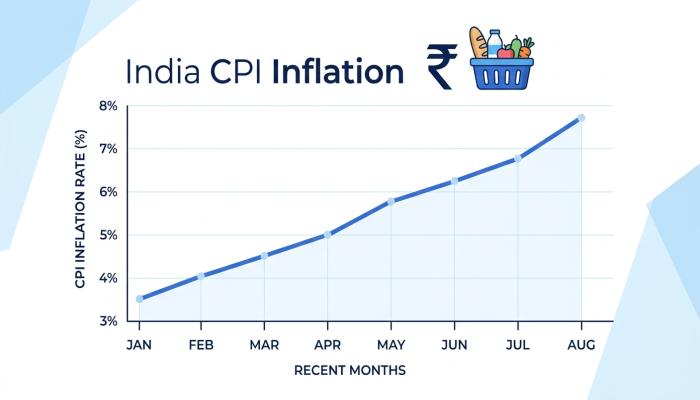
Inflation in India has been fairly moderate through 2026, though it has shown some ups and downs month to month. Based on official MoSPI data:
- January 2026: around 2.74%
- February 2026: around 3.21%
- March 2026: around 3.4%
- April 2026: around 3.48%
- May 2026: around 3.93%
- June and July 2026: inflation moved further up, with year-on-year CPI touching the 4% to 4.5% range according to available tracking sources
So through the first half of 2026, inflation in India moved from below 3% to closer to the RBI’s medium-term target zone. This kind of gradual movement is fairly normal. It reflects changes in food prices, fuel costs, and seasonal factors like harvests and monsoon conditions.
Since inflation data is updated every month, I would suggest checking the latest MoSPI press release or a reliable financial data source for the most current figure before making any decisions.
Inflation Rate in India Last 10 Years: A Quick Look Back
Looking at the last decade gives useful context. Over roughly the last 10 years, India’s average inflation rate has generally stayed in the 4% to 6% range, based on long-term CPI averages tracked by government and independent data sources.
Some broad patterns worth knowing:
- There have been periods of higher inflation, especially when global crude oil prices spiked or when supply chains were disrupted.
- There have also been periods of unusually low inflation, particularly when food prices fell sharply due to good harvests.
- The RBI has an inflation targeting framework, aiming to keep CPI inflation at around 4%, with a tolerance band of plus or minus 2 percentage points (so broadly between 2% and 6%).
This target band is important. When inflation moves outside this range for a sustained period, the RBI is expected to explain why and adjust its policy tools, mainly interest rates, to bring inflation back within range.
For exact historical numbers year by year, I would recommend checking the RBI’s official publications or MoSPI’s historical CPI data, since these figures get revised and updated over time.
Inflation Rate in India for Next Years: What to Expect
Predicting inflation with certainty is not possible, even for professional economists. However, a few general factors are usually considered when people try to estimate where inflation is headed:
1. Monsoon and Agricultural Output India’s food inflation is closely tied to monsoon performance. A good monsoon usually means better crop output and lower food prices. A weak or delayed monsoon can push food inflation up.
2. Global Crude Oil Prices India imports a large share of its crude oil. When global oil prices rise, transport and fuel costs go up, which can push overall inflation higher.
3. RBI Monetary Policy The RBI uses tools like the repo rate to manage inflation. When inflation rises, the RBI may keep interest rates higher for longer to cool down demand. When inflation is under control, there is more room to consider rate cuts.
4. Government Policy and Global Trade Conditions Import duties, export restrictions on food items, currency movements, and global trade or geopolitical tensions can all influence domestic prices.
Some research and rate forecasts suggest inflation may settle in the 4% range over the next couple of years, but these are projections, not guarantees. Actual numbers depend on real-world events that are hard to predict months in advance. I would treat any long-term inflation forecast as a rough guide, not a fixed prediction.
Also Read: Max Life Insurance: Policy Details, Login Process, and What You Should Know
Why Inflation Rate Matters for Traders and Investors
If you are into stock trading or investing, inflation data is not just a macroeconomic statistic. It has real, practical effects:
1. Impact on Interest Rates
When inflation rises, the RBI often responds by keeping interest rates high or raising them further. Higher interest rates can make borrowing costlier for companies, which can affect corporate earnings and, in turn, stock prices.
2. Impact on Sector Performance
Some sectors react differently to inflation:
- Banking and financial stocks are closely watched around interest rate decisions.
- FMCG (fast-moving consumer goods) companies may face pressure on margins if input costs rise faster than they can pass on to consumers.
- Export-oriented sectors can be affected by currency movements linked to inflation differences between countries.
3. Impact on Bond and Debt Markets
Inflation directly affects bond yields. When inflation is high, bond prices generally fall because investors demand higher yields to compensate for the loss in purchasing power.
4. Impact on Real Returns
If your investments are earning 6% per year but inflation is running at 5%, your real (inflation-adjusted) return is only about 1%. This is why looking at nominal returns alone can be misleading. Traders and long-term investors both need to account for inflation when evaluating actual portfolio performance.
Common Questions and Confusions Around Inflation Data
Many readers get confused about a few things related to inflation reporting. Let me clear these up in simple terms.
Confusion: “Inflation fell, so prices came down.” This is a common misunderstanding. A lower inflation rate does not mean prices have dropped. It means prices are rising at a slower pace than before. Prices rarely fall overall in a growing economy; they just grow more slowly when inflation cools down.
Confusion: “CPI and WPI show the same thing.” CPI measures prices paid by consumers (retail level), while WPI measures prices at the wholesale or producer level. They can move differently and are used for different purposes.
Confusion: “One month’s data tells you the full trend.” Monthly inflation numbers can be noisy, sometimes moved by a single item, like a spike in vegetable or pulses prices. It’s more useful to look at trends over several months rather than reacting to just one report.
Practical Tips for Readers Tracking Inflation
- Check the official MoSPI press release each month for the most accurate, updated CPI figures.
- Don’t rely only on headline numbers from social media; verify from RBI or government sources when it matters for a decision.
- If you are investing for the long term, think in terms of “real return” (return minus inflation), not just the headline return figure.
- Keep an eye on RBI’s Monetary Policy Committee (MPC) statements, since these often explain how the central bank is reading current inflation trends.
- Avoid making sudden trading decisions based on a single inflation data release. Look at the broader pattern and other economic indicators together.
Who Should Pay Close Attention to Inflation Data
- Active traders in equity, currency, or bond markets, since inflation data can move markets around release time.
- Long-term investors planning retirement or wealth goals, since real returns depend on inflation.
- Small business owners and salaried individuals, since inflation affects cost of living and pricing decisions.
Who May Not Need to Track It Closely
If you are a very long-term, passive investor with a diversified portfolio and no immediate need to trade around economic events, you may not need to track monthly inflation releases in detail. A quarterly or half-yearly check may be enough to understand broad trends.
FAQ
Q1: What is the current inflation rate in India?
Inflation in India has generally been moving between roughly 3% and 4.5% through 2026, though the exact figure changes every month. Please check the latest MoSPI or RBI release for the most current number.
Q2: What is a “good” inflation rate for India?
The RBI targets CPI inflation of around 4%, with a comfortable range of 2% to 6%. Numbers within this band are generally seen as manageable for the economy.
Q3: Does high inflation always mean the stock market will fall?
Not necessarily. Markets react to many factors together, including corporate earnings, global cues, and interest rate expectations, not inflation alone. However, sustained high inflation can create pressure on interest rates, which markets do watch closely.
Q4: Where can I check official inflation data for India?
The MoSPI website publishes monthly CPI press releases. The RBI website also has inflation-related reports and Monetary Policy Committee statements.
Q5: How does inflation affect my fixed deposits or savings?
If your fixed deposit interest rate is lower than the inflation rate, your money’s real value is technically declining even though the number on your account is going up. This is an important point to consider while planning long-term savings.
Conclusion
Inflation rate in India is one of the key numbers that shapes interest rates, market sentiment, and your real investment returns. Through 2026, inflation has moved from relatively low levels early in the year to a more moderate range in the following months, generally staying within the RBI’s target band. Looking ahead, monsoon performance, global oil prices, and RBI policy decisions will likely keep influencing the trend.
As a trader or investor, the most useful habit is to track the pattern over time rather than reacting to any single month’s number, and to always account for inflation when judging your actual, real returns.
Disclaimer
This article is for educational and informational purposes only. It is not financial or investment advice. Inflation and economic data change over time; please verify the latest figures from official sources like MoSPI and RBI before making any financial decisions. Always consider consulting a qualified financial advisor for personalized guidance.