If you are new to the Indian stock market, one of the first things you should understand is share trading time.
Knowing the market opening and closing time helps you place orders correctly, understand price movements, and avoid confusion when your broker shows that the market is closed.
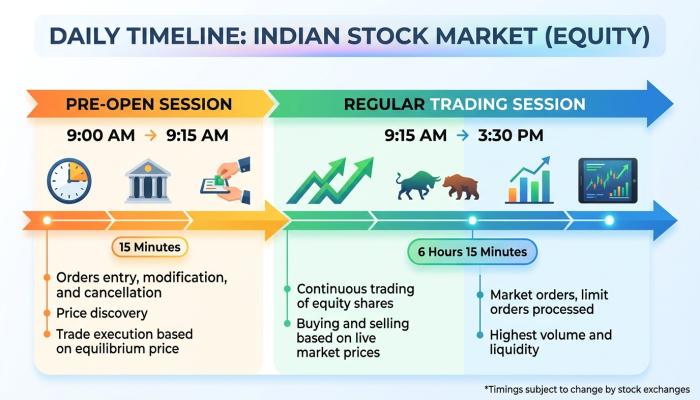
For normal equity trading on the NSE and BSE, the main trading session generally runs from 9:15 AM to 3:30 PM Indian Standard Time (IST) on trading days. There is also a pre-open session from 9:00 AM to 9:15 AM.
But there is more to stock market timings than simply remembering 9:15 AM to 3:30 PM.
In this guide, I will explain share trading time in India, pre-open trading, normal trading hours, post-market sessions, weekends, holidays, and some practical points beginners should know.
Table of Contents
What Is Share Trading Time?
Share trading time means the period during which investors and traders can place and execute orders on a stock exchange.
In India, the two major stock exchanges are the National Stock Exchange (NSE) and BSE Ltd. (BSE).
For the normal equity market, continuous trading takes place from 9:15 AM to 3:30 PM.
The exchanges also have sessions before and after the main market.
So, when someone asks about share market time open and close, the simple answer is:
- Pre-open session: 9:00 AM to 9:15 AM
- Regular equity trading: 9:15 AM to 3:30 PM
- Post-close/closing-related sessions: timings can vary by exchange and market segment
The exact session can also depend on the type of security or product being traded.
Share Trading Time in India at a Glance
| Session | Time | Purpose |
|---|---|---|
| Pre-open session | 9:00 AM–9:15 AM | Opening price discovery |
| Normal equity market | 9:15 AM–3:30 PM | Regular share trading |
| Closing-related session | After 3:30 PM | Depends on exchange/session |
| NSE equity derivatives | 9:15 AM–3:40 PM | Futures and options trading |
NSE currently lists normal equity market hours as 9:15 AM to 3:30 PM and equity derivatives hours as 9:15 AM to 3:40 PM.
This difference is important. Equity shares and derivatives do not always have exactly the same trading hours.
What Happens Before 9:15 AM?
Many beginners think nothing happens before 9:15 AM.
That is not correct.
The Indian stock market has a pre-open session from 9:00 AM to 9:15 AM for the relevant equity market process.
The purpose is to help determine the opening price of stocks.
9:00 AM to 9:08 AM: Order Collection
During this period, eligible orders can generally be entered, modified, or cancelled.
However, the order-entry period can close randomly during the final minute.
This is designed to reduce the possibility of traders trying to influence the opening price at the last second.
9:08 AM to Around 9:12 AM: Order Matching
After order collection ends, the exchange starts matching orders.
The opening price is determined through an auction mechanism based on available buy and sell orders.
The objective is to find an equilibrium price where the maximum possible quantity can be matched.
9:12 AM to 9:15 AM: Transition
There is a short transition period before the regular market begins.
Then normal trading starts at 9:15 AM.
What Is the Normal Share Trading Time?
The main equity trading session is:
9:15 AM to 3:30 PM
This is the period most people mean when they talk about Indian stock market timings.
During this period, buyers and sellers can trade eligible shares through their brokers.
The exchange matches orders according to its applicable order-priority rules.
For a normal investor, the important thing to remember is simple:
Regular Indian equity trading normally starts at 9:15 AM and ends at 3:30 PM.
NSE’s current market-timing information confirms these normal equity market hours.
Is 3:30 PM the Exact End of All Stock Market Activity?
Not necessarily.
This is an important distinction.
The normal continuous equity trading session ends at 3:30 PM. But certain closing, post-close, auction, or other market processes can continue after that.
For example, NSE provides separate closing-auction and post-close processes for applicable securities.
BSE documentation also describes a post-closing session after the continuous trading period.
So you should not assume that every market-related activity stops exactly at 3:30 PM.
However, if you are a beginner mainly interested in buying or selling ordinary shares, 9:15 AM to 3:30 PM is the key timing to remember.
What Is the Best Time to Trade Shares?
There is no universal “best” share trading time.
Different traders use different strategies.
I would be careful with websites that claim one particular time guarantees better profits. There is no such guarantee.
Still, different parts of the trading day can behave differently.
9:15 AM to 10:00 AM
The first part of the regular session can be active.
Prices may move quickly because traders are reacting to overnight news, global market movements, company announcements, and the opening price.
This can create opportunities, but it can also create more volatility.
For beginners, fast price movements can make emotional decisions more likely.
10:00 AM to 1:00 PM
Market activity may become calmer for some stocks during parts of this period.
That does not mean prices cannot move sharply.
Company news, economic announcements, global events, and unexpected developments can affect the market at any time.
1:00 PM to 3:00 PM
Trading continues normally.
Liquidity and volatility vary from stock to stock.
There is no rule that this period is automatically safer or more profitable.
3:00 PM to 3:30 PM
The final part of the normal session can become active as traders adjust positions before the market closes.
Again, this does not automatically make it a better time to trade.
The right approach depends on your strategy, risk level, liquidity, and the particular security.
Also Read: Trading Companies in India: How They Work and What Traders Should Know
Share Market Time on Saturday and Sunday
For the normal equity market, NSE states that trading takes place on trading days and excludes Saturdays, Sundays, and exchange-declared holidays.
So for normal share trading:
- Monday — Usually open
- Tuesday — Usually open
- Wednesday — Usually open
- Thursday — Usually open
- Friday — Usually open
- Saturday — Closed
- Sunday — Closed
“Usually” is important because exchange holidays can change the schedule.
Before planning a trade around a particular date, check the latest exchange holiday calendar.
What Happens on Stock Market Holidays?
The NSE and BSE publish trading holiday calendars.
On declared holidays, the normal market is closed.
There can also be special sessions.
For example, NSE’s current information notes that Muhurat Trading for Diwali Laxmi Pujan is conducted on a separately notified schedule.
Therefore, do not assume that every festival day follows the same schedule every year.
If you are planning a trade around a holiday, check the latest NSE or BSE notification.
Share Trading Time for Futures and Options
If you trade derivatives, do not use the equity closing time without checking the relevant segment.
NSE currently lists:
Equity derivatives: 9:15 AM to 3:40 PM.
That is different from the normal equity market, which closes at 3:30 PM.
This is one reason beginners should understand what they are actually trading before placing an order.
A share, futures contract, option, currency product, and other market instruments may have different rules and timings.
How to Start Share Trading
Knowing the share trading time is only one part of getting started.
If you are completely new, the basic process is usually:
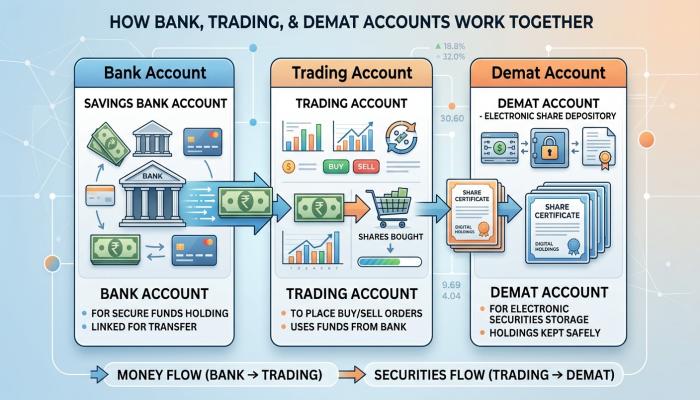
1. Open a Demat and Trading Account
You need an account with a SEBI-regulated broker or relevant intermediary to access the market.
A Demat account is used to hold securities electronically.
A trading account is used to place trades.
2. Complete KYC
You will normally need to complete the required KYC process and provide the necessary documents.
Requirements can vary depending on the intermediary.
3. Add Funds
If you plan to buy shares, you need sufficient funds in the appropriate account.
Always understand how your broker handles funds and withdrawals.
4. Learn Basic Order Types
At minimum, understand:
- Market order
- Limit order
- Stop-loss order
A market order generally seeks execution at available market prices.
A limit order allows you to specify the maximum price you are willing to pay when buying, or minimum price you are willing to accept when selling.
Order execution is not guaranteed simply because you entered an order.
5. Check the Market Timing
Before placing an order, check whether the market is open and whether the security is eligible for the session you are using.
This simple habit can prevent many beginner mistakes.
Does a Share Trading Company Control the Market Timing?
No.
A broker or share trading company provides access to the exchange and its trading systems.
The exchange determines its trading sessions under the applicable regulatory and exchange framework.
Your broker may have its own app timings, order policies, fund-transfer cut-offs, or support hours.
Therefore, do not confuse broker operating hours with stock exchange trading hours.
For example, your broker’s customer support may not be available throughout the entire market session.
Common Problems Beginners Face
“I Placed an Order Before 9:15 AM”
Depending on the broker and order type, your order may be handled through a pre-open process or queued according to the broker’s rules.
Do not assume that an order entered before 9:15 AM will automatically execute at the price you want.
“My Order Did Not Execute”
An order can remain unexecuted if there is no matching counter-order at your specified price or under the applicable trading conditions.
For example, a limit buy order at ₹100 does not guarantee that you will receive shares at ₹100.
Someone must be willing to sell at a matching price.
“The Market Is Open but My Stock Is Not Moving”
Some securities can have lower trading activity.
Certain stocks may also be subject to special trading mechanisms, price bands, auctions, or other exchange rules.
Check the stock’s trading status instead of assuming there is a technical problem with your broker.
What Should You Check Before Trading?
Before placing an order, I suggest checking these basic things:
- Is today a trading day?
- Is the exchange currently open?
- Is the stock actually tradable?
- Am I trading equity or derivatives?
- What order type am I using?
- What price am I entering?
- What charges will apply?
- How much money am I risking?
- Is the stock sufficiently liquid?
- Have I checked the latest exchange and broker information?
These questions may look simple, but they can prevent avoidable mistakes.
Share Trading Time vs Investing Time
Trading and investing are not exactly the same.
A short-term trader may pay close attention to market hours and intraday price movements.
A long-term investor may be more focused on the company’s business, financial results, valuation, risks, and long-term prospects.
So, knowing market hours is useful for everyone, but the importance of minute-by-minute price movements depends on your approach.
Frequently Asked Questions
What is the share trading time in India?
For normal equity trading, the main session is generally 9:15 AM to 3:30 PM IST on trading days. The pre-open session runs from 9:00 AM to 9:15 AM.
What time does the Indian stock market open?
The normal equity market opens at 9:15 AM IST. The pre-open session begins at 9:00 AM.
What time does the Indian stock market close?
The normal equity trading session closes at 3:30 PM IST. Some separate closing and post-close processes can continue after this.
Can I trade shares on Saturday and Sunday?
Normal NSE equity trading is not conducted on Saturdays and Sundays. Exchange-declared holidays also affect the schedule.
Is there a best time to trade shares?
There is no single best time for everyone. Different periods of the trading day can have different levels of volatility and liquidity. Your strategy and risk management matter more than simply choosing a particular time.
Conclusion
Understanding share trading time is one of the basic steps every Indian market participant should take.
For normal equity trading, remember the key timing:
Pre-open: 9:00 AM–9:15 AM
Regular equity trading: 9:15 AM–3:30 PM
If you trade futures and options, remember that the timing can be different. NSE currently lists equity derivatives trading until 3:40 PM.
Most importantly, do not treat market timing as a shortcut to making money. A market can move sharply at any time.
Before trading, check the latest exchange schedule, understand your broker’s order process, and know the risks of the product you are trading.
Disclaimer
This article is for educational and informational purposes only. It is not financial advice or a recommendation to buy or sell any security. Market timings, trading rules, charges, and exchange procedures can change, so always verify the latest information from the relevant exchange and your broker before trading.