Max Life Insurance: Policy Details, Login Process, and What You Should Know
If you are researching Max Life Insurance, chances are you already have a policy, you’re thinking of buying one, or you’re simply trying to log in and check your policy status. This guide covers all three. I’ll walk you through how the company works today, what its plans generally offer, how the login and policy-check process works, common problems people face, and things you should personally verify before making any decision.
One important update first: Max Life Insurance is now officially known as Axis Max Life Insurance, following a rebrand in December 2024. The company itself hasn’t disappeared — it’s the same insurer, same policies, same claim history — but the name change affects the website you’ll use and some of the branding you’ll see. I’ll refer to it as Max Life / Axis Max Life through this article since both names are still in common use.
Table of Contents
What Is Max Life Insurance (Axis Max Life)?
Max Life Insurance was founded in 2000 and has grown into one of India’s larger private life insurers. It is a joint venture, with Max Financial Services holding the majority stake and Axis Bank holding a minority stake. This bank partnership is one reason you may have first heard about Max Life through an Axis Bank branch or app — bank-backed insurers often sell policies through the bank’s branch network, which is called bancassurance.
The company offers a mix of:
- Term insurance plans – pure protection plans that pay a lump sum to your family if something happens to you.
- ULIPs (Unit Linked Insurance Plans) – plans that combine life cover with market-linked investment.
- Savings and guaranteed return plans – traditional plans offering fixed or predictable payouts.
- Retirement and pension plans
- Child plans – aimed at funding a child’s education or future needs.
- Group insurance – typically bought by employers for employees.
Like most large insurers, its exact plan names, variants, and features get updated from time to time, so always check the latest details on the official Axis Max Life website before comparing or buying anything.
Max Life Insurance Policy Details: What to Check
If you already hold a policy, your policy document (sometimes called the policy bond) is the single most reliable source for your actual terms. Don’t rely only on what an agent told you verbally. Here’s what your policy details typically include:
- Policy number – your unique identifier, needed for almost every online or offline service request.
- Sum assured – the amount payable on death or maturity, depending on the plan type.
- Premium amount and payment frequency – monthly, quarterly, half-yearly, or yearly.
- Policy term and premium payment term – these can be different. Some plans let you pay premiums for a shorter period while the cover continues longer.
- Riders – add-ons like critical illness cover, accidental death benefit, or waiver of premium, if you opted for any.
- Nominee details – the person who will receive the payout.
- Fund details (for ULIPs) – which funds your premium is invested in, if applicable.
If any of these details look wrong on your policy document, raise it with the insurer immediately through their customer service channels rather than waiting.
How to Log In to Max Life Insurance (Axis Max Life) Online
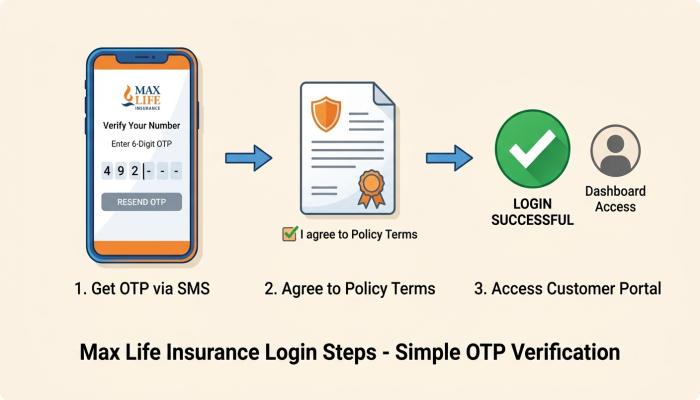
The customer portal is meant to let you check policy status, pay premiums, download documents, update details, and raise service requests without visiting a branch. The general login process works like this:
- Go to the official Axis Max Life Insurance website.
- Click on “Customer Login,” usually placed in the top-right corner of the homepage.
- Choose how you want to log in — this is usually your registered mobile number, email ID, or policy number.
- Enter the required detail along with your date of birth.
- You’ll typically receive an OTP on your registered mobile number or email, which you enter to complete login. Some accounts also allow a password-based login as an alternative to OTP.
Max Life Insurance Login With Policy Number
If you choose to log in using your policy number, keep these ready:
- Your policy number (exactly as printed on your policy document)
- Your date of birth as registered with the insurer
- Access to your registered mobile number or email for OTP verification
A common mistake here is typing the policy number with extra spaces or missing digits, which causes a login failure. Double-check it character by character if the system rejects it.
First-Time Registration
If you’ve never logged in before, look for a “New User” or “Register Here” option on the login page. You’ll usually need your policy number, date of birth, and registered mobile number to complete registration, after which you set up your own password or continue using OTP-based login going forward.
Common Login and Access Problems
A few issues come up repeatedly for policyholders, based on what’s widely reported by users and covered in insurer help sections:
OTP not received. This usually happens because the mobile number on file is outdated, in poor network coverage, or the SMS is delayed due to network congestion. Try requesting the OTP again after a few minutes, and check that your registered number is still active.
Login details not matching. If your name, date of birth, or mobile number was entered incorrectly at the time of buying the policy, the system may not recognise your login attempt. In this case, you’ll likely need to raise a service request or visit a branch with ID proof to correct your records.
Forgotten password. Most portals have a “Forgot Password” link where you enter your registered ID (email, mobile, or policy number), and a reset link or OTP is sent to you.
Policy not visible after login. Sometimes a policy doesn’t show up immediately after purchase because of a processing delay, or because it was bought under a slightly different registered detail (for example, a different email than the one you’re using to log in). Contacting customer support with your policy number usually resolves this.
Also Read: Stock Analysis: Simple Guide for Indian Investors 2026
Charges and Costs You Should Know About
Charges vary by plan type, so I won’t quote exact figures here — always check the benefit illustration and policy document for your specific plan, since these numbers change and outdated figures can be misleading. Broadly, though, here’s what to be aware of as categories:
- Premium allocation charges (mainly in ULIPs) – a portion of your premium may go toward charges before the rest is invested.
- Fund management charges (ULIPs) – an annual charge for managing your invested fund.
- Mortality charges – the cost of providing the life cover itself.
- Policy administration charges – ongoing charges for maintaining your policy.
- Surrender charges – if you exit a plan early, especially ULIPs or savings plans, you may not get back the full amount you’ve paid.
One update worth knowing: GST on individual life insurance premiums was removed effective September 2025, which has made premiums somewhat more affordable compared to before. That said, tax rules can change, so confirm the current applicable tax treatment before you calculate your final premium outgo.
Advantages of Max Life / Axis Max Life Insurance
- Long operating history (since 2000) and a large customer base.
- Strong claim settlement ratio in recent financial years, which is one of the more important metrics when choosing a life insurer, since it reflects how reliably claims actually get paid.
- Backing from two established financial groups (Max Financial Services and Axis Bank), which adds a degree of institutional stability.
- Wide variety of plan types, so you can compare term, ULIP, and savings options under one insurer if you prefer.
- Digital-first service options, reducing dependence on branch visits for routine tasks.
Limitations or Things to Be Careful About
- Brand transition confusion. Since the name recently changed to Axis Max Life, some older documents, cheque books, or third-party listings may still say “Max Life,” which can confuse first-time visitors trying to find the right website.
- ULIP charges reduce early returns. If you’re buying a ULIP, understand that charges are typically front-loaded, so early surrender usually gives a lower return than staying invested for the recommended horizon.
- Riders add cost. Extra riders (critical illness, accidental cover, etc.) increase your premium, so evaluate whether you need them rather than adding them by default.
- Claim settlement ratio isn’t a guarantee for your specific claim. It’s a useful indicator of the insurer’s overall track record, but individual claims still depend on accurate disclosure at the time of buying the policy — undisclosed health conditions or false information can lead to claim rejection regardless of the insurer’s overall ratio.
Who Might Find This Useful
People looking for a private insurer with a long track record, a mix of protection and investment-linked products, and a strong digital self-service portal may find Axis Max Life worth evaluating. It can also suit existing Axis Bank customers who prefer managing insurance and banking with related institutions.
Who Should Be More Cautious
If you’re looking purely for the cheapest possible term cover, it’s worth comparing premium quotes across 3–4 insurers rather than assuming any single brand is automatically the most cost-effective for your profile. Premiums depend heavily on your age, health, and sum assured, and they differ insurer to insurer.
Practical Tips Before You Buy or Renew
- Always read the benefit illustration, not just the brochure.
- Confirm whether the plan is a ULIP, traditional plan, or pure term plan — these behave very differently in terms of risk and returns.
- Check the free-look period (the window after buying where you can cancel and get a refund if you’re not satisfied) and its exact terms.
- Keep your registered mobile number and email updated with the insurer at all times — most login and claim issues trace back to outdated contact details.
- Save your policy document (physical or digital) somewhere your family can access it, since sum assured and nominee details matter most during a claim.
Frequently Asked Questions
1. Is Max Life Insurance the same as Axis Max Life Insurance? Yes. Max Life Insurance Company Ltd. was rebranded as Axis Max Life Insurance Limited in December 2024. It’s the same company and the same set of policies, just under an updated name and branding.
2. How do I check my Max Life Insurance policy status online? Log in to the customer portal using your registered mobile number, email, or policy number along with your date of birth, and verify with the OTP sent to you. Once logged in, your policy status, premium due dates, and documents are usually visible on your dashboard.
3. What should I do if I can’t log in with my policy number? First recheck that you’ve entered the policy number and date of birth exactly as per your policy document. If it still fails, use the “Forgot Password” option, or contact customer support to confirm which contact details are registered against your policy.
4. Can I pay my premium without logging in? Many insurers, including Axis Max Life, typically offer a “Quick Pay” or similar option where you can pay a premium using just your policy number and date of birth, without a full login. Check the current premium payment page on the official website to confirm this is still available and how it works.
5. Is Axis Max Life Insurance safe to invest in? It is regulated by the IRDAI (Insurance Regulatory and Development Authority of India), like all life insurers operating in India. Regulation doesn’t mean zero risk in market-linked products like ULIPs, but it does mean the company operates under defined solvency and conduct rules. Always assess a plan based on your own risk appetite, especially for market-linked options.
Conclusion
Max Life Insurance, now Axis Max Life Insurance, remains one of the more established private life insurers in India, with a wide range of term, ULIP, savings, and retirement products. Whether you’re logging in to check an existing policy or comparing plans before buying, the most useful habit is simple: rely on your actual policy document and the official website for specifics, rather than assuming charges, features, or processes stay the same over time. Insurance products and portals get updated, so a quick check before you act can save you confusion later.
Disclaimer
This article is for educational and informational purposes only and does not constitute financial or investment advice. Charges, features, plan names, and processes mentioned here may change over time — please verify current details directly with Axis Max Life Insurance or through the official website before making any decision. This is not a recommendation to buy, hold, or avoid any specific insurance product.