If you are planning to invest in Indian shares, you will often hear the word demat. But what exactly is a demat account? Is it the same as a trading account? How do you open one? What charges apply?
In simple words, a demat account is used to hold your shares and other securities in electronic form. A trading account is used to place buy and sell orders in the market.
SEBI explains that a demat account is opened with a registered Depository Participant (DP) for holding and transferring securities, while a trading account is used for trading through a stock broker.
In this guide, I will explain demat accounts in simple language. I will also cover how a demat account works, the difference between a demat and trading account, account opening, charges, BSDA, and the common things you should check before opening one.
Table of Contents
What Is a Demat Account?
A demat account is an electronic account where your investments are held.
The word “demat” comes from dematerialisation. It means converting physical securities into electronic form.
Today, when you buy shares through the stock market, you normally do not receive physical share certificates. The securities are credited to your demat account in electronic form.
A demat account can hold investments such as:
- Equity shares
- Bonds
- Government securities
- Debentures
- Exchange-traded funds (ETFs)
- Some mutual fund units and other eligible securities
SEBI’s investor material explains that securities are held electronically through the depository system. India has two main depositories, NSDL and CDSL, while investors access these services through Depository Participants.
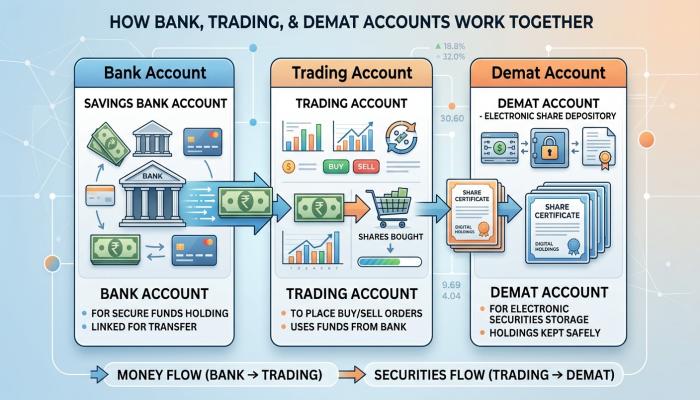
Bank account → holds your money
Demat account → holds your securities
Trading account → helps you buy and sell securities
That simple comparison makes the role of each account easier to understand.
Demat Account Meaning in Simple Words
The easiest demat account meaning is:
A demat account is an electronic account used to hold securities such as shares and bonds.
For example, suppose you buy 20 shares of a company.
The money is paid from your linked bank account. The buy order is placed through your trading account. Once the transaction is settled, the shares are credited to your demat account.
Later, if you sell those shares, the securities are debited from your demat account as part of the settlement process.
So, the demat account mainly acts as the place where your investments are stored.
Demat Account vs Trading Account
Many new investors confuse these two accounts.
They are connected, but they have different jobs.
| Account | Main purpose |
|---|---|
| Bank account | Holds and transfers money |
| Trading account | Used to place buy and sell orders |
| Demat account | Holds securities electronically |
SEBI also describes these as separate parts of the investment process. For investing in shares, investors generally need a bank account, trading account and demat account.
Example
Suppose you want to buy shares worth ₹10,000.
- Money is available in your bank account.
- You place the order through your trading account.
- After settlement, the shares are credited to your demat account.
- When you sell them later, the shares are debited from the demat account and the sale proceeds go through the trading and bank settlement process.
This is why a demat account and trading account are not exactly the same thing.
Do You Need a Demat Account for Trading?
For normal delivery-based equity investing, yes, you need a demat account to hold the shares.
However, the exact account requirement can depend on the product and transaction type.
For example, different rules and settlement processes can apply to derivatives, mutual funds, bonds and other products.
If you are a beginner mainly interested in buying shares and holding them, having a demat account is an important part of the process.
How Does a Demat Account Work?
The process is fairly simple.
Step 1: Open a demat and trading account
You choose a SEBI-registered intermediary or broker and complete the account-opening and KYC process.
Step 2: Add money
Money is transferred through the linked bank account according to the broker’s process.
Step 3: Place an order
You use the trading platform to place a buy order.
Step 4: Order execution
If your order matches in the market, the trade is executed.
Step 5: Settlement
After the applicable settlement process is completed, the purchased securities are credited to your demat account.
This means you do not have to manage physical share certificates.
How to Open a Demat Account
The demat account open process is now mostly digital with many brokers.
Usually, you will need to complete KYC and provide the information requested by the intermediary.
Depending on the account and provider, the process can include:
- PAN details
- Identity information
- Address information
- Bank details
- Mobile number
- Email address
- KYC verification
- Video or other identity verification
SEBI has also provided investor guidance around opening demat and trading accounts and KYC requirements.
The exact documents and verification process can change, so I recommend checking the latest requirements on the official website of the broker or Depository Participant before applying.
Can You Open a Demat Account Without a Trading Account?
Technically, a demat account and trading account are different accounts.
A demat account is for holding securities. A trading account is for buying and selling through a stock broker.
Axis Bank, for example, explains that its integrated setup combines bank, demat and trading services, while also stating that a trading account is needed for transactions through a stock broker.
For a person who wants to actively buy and sell listed shares, having both accounts is therefore usually the practical setup.
What Are Demat Account Charges?
A demat account is not always completely free.
There can be different types of charges, depending on the provider and the services you use.
Common charges may include:
Annual Maintenance Charge
This is commonly called AMC.
It is charged for maintaining the demat account. The amount can depend on the account type and provider.
Transaction Charges
Some activities involving the debit or transfer of securities may attract charges.
Pledge Charges
If eligible securities are pledged for a facility such as margin, applicable charges may apply.
Other Service Charges
There may also be charges for certain statements, physical documents, rejected instructions, rematerialisation or other services.
The important point is that demat charges are not the same for every broker or DP.
Always check the latest schedule of charges before opening an account.
Demat Account Charges Axis Bank
The search term demat account charges Axis Bank can be confusing because Axis Bank has different account arrangements, customer categories and service schedules.
Axis Bank’s current public demat information says there is no charge for opening an Axis Direct Trading & Demat account, while it also explains that regular demat and BSDA accounts can have different maintenance-charge structures.
Axis Bank also publishes BSDA information showing that eligible accounts can have lower AMC based on the value of securities held. Its published BSDA criteria state that the holding value must not exceed ₹10 lakh and that no AMC is levied up to ₹4 lakh; for holdings above ₹4 lakh and up to ₹10 lakh, AMC can be charged up to ₹100.
There is an important caution here.
Some older Axis Bank charge documents available online contain older tariff figures. For example, one schedule is explicitly marked effective from 2018.
So I would not recommend using old articles or old PDFs to decide today’s charges.
Before opening an Axis demat account, check the latest official Axis Bank/Axis Securities fee schedule and the specific account type you are applying for.
Also Read: NPS Interest Rate: How Returns Work and What You Should Know Before Investing
What Is a BSDA Account?
BSDA means Basic Services Demat Account.
It is designed for eligible investors who want a demat account with lower maintenance costs.
The current framework has made BSDA more useful for smaller investors. Axis Bank’s published BSDA criteria state that an individual can have only one BSDA in their name across depositories and that the value of securities should not exceed ₹10 lakh.
The AMC structure is linked to the value of holdings.
According to Axis Bank’s published information:
- Up to ₹4 lakh: no AMC
- Above ₹4 lakh and up to ₹10 lakh: AMC not exceeding ₹100
Eligibility conditions apply, so do not assume that every demat account automatically qualifies as BSDA.
For a small investor, checking BSDA eligibility can be worthwhile.
Benefits of Having a Demat Account
A demat account makes holding securities much easier than using physical certificates.
Electronic holding
Your securities are stored electronically.
Easier tracking
You can normally view your holdings through the relevant platform or statement.
Reduced paperwork
You do not need to maintain physical share certificates for securities held in demat form.
Convenient transfers
Eligible securities can be transferred electronically using the available depository facilities.
Useful for long-term investors
If you plan to hold shares for several years, a demat account provides the basic infrastructure needed to hold those securities electronically.
Limitations and Things to Watch
A demat account also has some practical disadvantages.
Charges can vary
A “free account” may only mean that there is no account-opening fee.
Other charges can still apply.
AMC may apply
A regular demat account may have annual maintenance charges depending on the provider and account type.
Multiple accounts can become difficult to manage
Some investors open several demat accounts without a clear reason.
This can make tracking holdings and charges more complicated.
Security is important
Your login details, OTPs and transaction authorisations should be kept private.
Never share an OTP, password, PIN or other confidential authentication details with someone claiming to be a broker representative.
Rules can change
SEBI, depositories, brokers and banks can change processes and charges.
So information found in an old blog post may not match today’s terms.
How to Choose a Demat Account
I would suggest looking at more than just the account-opening fee.
Before opening an account, check:
- Annual maintenance charge
- Brokerage structure
- Other transaction charges
- Account closure charges, if any
- Trading platform usability
- Customer support options
- Security features
- Contract notes and statements
- BSDA eligibility
- Current terms and conditions
A low account-opening fee does not automatically mean the account is cheaper overall.
For active traders, brokerage and transaction costs can matter more.
For long-term investors, AMC and other account-related costs may be more important.
Common Demat Account Problems
Most demat-related problems are not complicated, but they can be frustrating.
Shares are not showing
First check whether the trade has completed settlement. Also check whether you are looking at the correct demat account.
Wrong quantity appears
Check the contract note, trade details and latest demat statement. If the difference remains, contact the broker or DP.
Account is inactive
KYC or account-status issues can sometimes affect account operation. Follow the provider’s instructions for reactivation or updating details.
You do not understand a charge
Do not simply assume it is brokerage.
Check whether the charge relates to AMC, DP services, taxes, transaction processing or another service.
Ask the provider for the exact charge description if necessary.
Who Should Open a Demat Account?
A demat account can be useful if you want to:
- Hold listed shares
- Invest in ETFs
- Hold eligible bonds or securities
- Participate in the securities market
- Keep investments in electronic form
It may not make sense to open multiple accounts simply because opening them is easy.
Think about your actual investment needs first.
Practical Tips for Beginners
If you are opening your first demat account, keep things simple.
First, understand the difference between a bank, trading and demat account.
Second, read the current charges before submitting the application.
Third, check whether you qualify for BSDA.
Fourth, use only the official website or app of your broker or DP.
Fifth, keep your mobile number and email updated.
Sixth, review your holdings and transaction statements from time to time.
Finally, never choose an account only because an advertisement says it is “free”. Read what is actually free and what charges may apply later.
FAQ
What is a demat account?
A demat account is an electronic account used to hold securities such as shares, bonds and other eligible investments.
Is a demat account the same as a trading account?
No. A demat account mainly holds securities, while a trading account is used to place buy and sell orders through a stock broker.
Can I open a demat account online?
Yes. Many providers offer online account opening. You generally need to complete KYC and the required verification process.
What are demat account charges?
Depending on the provider, charges can include annual maintenance fees, transaction or transfer charges, pledge-related charges and fees for certain services.
What is the difference between a regular demat account and BSDA?
A BSDA, or Basic Services Demat Account, is designed for eligible investors and can have lower AMC based on the value of securities held. Eligibility conditions apply.
Conclusion
A demat account is one of the basic building blocks for investing in the Indian securities market.
Its main job is simple: it holds your securities electronically.
The trading account does a different job by allowing you to place buy and sell orders.
If you are opening an account for the first time, do not focus only on whether the account-opening fee is zero. Look at AMC, transaction charges, brokerage, platform quality, security and the provider’s current terms.
For smaller investors, it is also worth checking whether you qualify for a BSDA.
Most importantly, verify charges and rules from the official provider and SEBI sources before making a decision. Charges and account conditions can change over time.
Disclaimer
This article is for educational and informational purposes only. It is not financial advice or a recommendation to buy or sell any security. Stock-market investments involve risk. Always verify current charges, rules and account terms from the relevant broker, Depository Participant, bank, depository or SEBI before taking action.