If you have ever heard someone talk about Sensex, Nifty, or “the market crashed today” and felt a bit lost, you are not alone. A lot of people in India want to understand the stock market but find the topic confusing because of jargon and technical terms.
This article breaks down how the stock market works, how the Indian stock market fits into the bigger global picture, what you need to know before you start investing, and the common problems new investors face. I will also touch on stock market holidays and how global brokerage research (like reports from firms such as Jefferies) fits into the picture, without giving any specific buy or sell advice.
Table of Contents
What Is the Stock Market?
The stock market is a place, mostly online now, where people buy and sell small ownership pieces of companies. These pieces are called shares or stocks.
When a company wants to raise money to grow its business, it can sell shares to the public. Once those shares are listed, investors can buy and sell them among themselves through stock exchanges.
In India, the two main stock exchanges are:
- BSE (Bombay Stock Exchange) – one of the oldest exchanges in Asia
- NSE (National Stock Exchange) – currently the larger exchange in terms of daily trading volume
Prices of shares go up and down based on demand, company performance, economic news, and investor sentiment.
How the Indian Stock Market Works
The Indian stock market runs on a fairly simple structure, even though it looks complicated from the outside.
Key Players in the Market
- Investors and traders – individuals and institutions buying and selling shares
- Stock brokers – platforms or firms that give you access to place orders (like Zerodha, Groww, Upstox, and others)
- SEBI (Securities and Exchange Board of India) – the regulator that sets rules to protect investors
- Depositories (NSDL and CDSL) – where your shares are held electronically
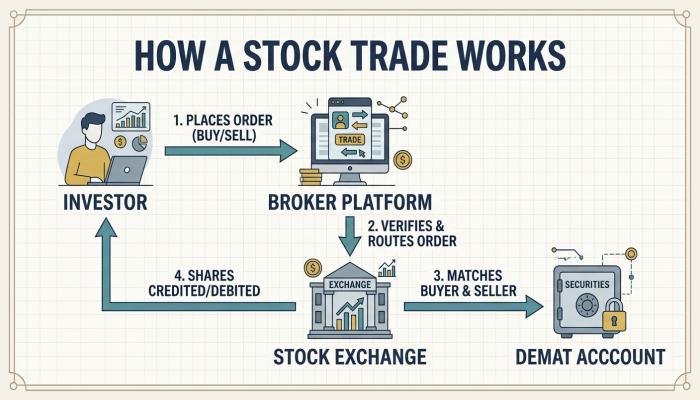
How a Trade Actually Happens
- You open a trading and demat account with a broker.
- You place a buy or sell order through the broker’s app or website.
- The exchange matches your order with someone on the other side.
- The trade settles, and shares move in or out of your demat account.
This entire process usually completes within a day or two, thanks to India’s electronic settlement system.
Also Read: Stock Analysis: Simple Guide for Indian Investors 2026
Understanding the World Stock Market Connection
The Indian stock market does not operate in isolation. Global events affect it almost every day.
For example:
- Movements in the US stock market (like the Dow Jones or Nasdaq) often influence how Indian markets open the next day.
- Global commodity prices, especially crude oil and metals, affect Indian companies that depend on imports or exports.
- International brokerage houses, including firms like Jefferies, regularly publish research reports on sectors such as metals, banking, and technology. These reports can influence short-term market sentiment when they highlight upgrades or downgrades on certain stocks or sectors.
It’s worth being clear here: research reports from firms like Jefferies reflect that firm’s own analysis and are not guaranteed predictions. They should never be treated as personal investment advice, and their views can change as market conditions change. If you come across specific stock picks from any brokerage, treat them as one input among many, not a final decision-making tool.
Stock Market Holidays in India
The Indian stock market is closed on weekends (Saturday and Sunday) and on specific holidays declared by NSE and BSE each year. These usually include major national and religious holidays.
Since exact holiday dates change every year and are officially announced by the exchanges, it’s best to check the latest holiday calendar directly on the NSE or BSE official website before planning your trades around a holiday. Relying on old lists can lead to confusion, especially around festival seasons when dates shift based on the calendar.
Important Features of Stock Market Investing in India
1. Demat and Trading Accounts
You need a demat account (to hold shares electronically) and a trading account (to place buy/sell orders). Most brokers now offer both together during account opening.
2. Different Ways to Invest
- Direct equity investing – buying individual company shares
- Mutual funds – pooled investment managed by professionals
- ETFs (Exchange Traded Funds) – funds that trade like stocks and track an index
- Derivatives (F&O) – futures and options, which are higher-risk instruments meant mainly for experienced traders
3. Market Timings
The regular trading session on NSE and BSE generally runs from morning to mid-afternoon on working days, with a pre-market session before that. Exact timings can occasionally be adjusted by the exchanges, so it’s a good habit to confirm current timings on the official exchange website, especially if you’re placing time-sensitive orders.
Benefits of Investing in the Stock Market
- Potential for long-term wealth creation compared to keeping money idle
- Ownership in businesses you believe in
- Liquidity – shares of most large companies can be bought or sold quickly
- Variety of options – from low-risk large-cap stocks to higher-risk small-cap stocks
Limitations and Risks You Should Know
- Market risk – share prices can fall due to company-specific or broader economic reasons
- No guaranteed returns – past performance of any stock or fund does not guarantee future results
- Emotional decision-making – panic selling or greedy buying often hurts more than market movements themselves
- Complexity of derivatives – F&O trading carries significant risk and is not suitable for everyone, especially beginners
- Charges and taxes – brokerage fees, transaction charges, STT (Securities Transaction Tax), and capital gains tax all affect your actual returns
Common Problems New Investors Face
Problem 1: Not Understanding What They Are Buying
Many new investors buy a stock just because someone recommended it, without knowing what the company does or its financial health.
Practical solution: Spend at least a few minutes reading about the company’s business, recent news, and basic financial numbers before investing.
Problem 2: Chasing Quick Profits
Some beginners treat the stock market like a shortcut to quick money, which often leads to losses.
Practical solution: Set realistic expectations. The stock market usually rewards patience more than speculation.
Problem 3: Ignoring Charges
Frequent buying and selling can quietly eat into profits through brokerage and other charges.
Practical solution: Check your broker’s charge structure carefully, and factor in charges before deciding how often to trade. Since charges can change, always confirm current rates on your broker’s official website.
Problem 4: Not Diversifying
Putting all your money into one stock or one sector increases risk significantly.
Practical solution: Spread investments across different sectors and, where appropriate, different asset types like mutual funds or ETFs.
Who May Find Stock Market Investing Useful
- People looking to grow savings over the long term
- Individuals comfortable with some level of risk
- Those willing to spend time learning before investing
- Investors looking for options beyond traditional fixed deposits
Who May Want to Be Cautious
- People who cannot afford to lose their invested capital
- Those looking for guaranteed, fixed returns
- Beginners wanting to jump directly into high-risk derivatives without understanding the basics
- Anyone investing borrowed money they cannot afford to lose
Practical Tips Before You Start
- Start small and increase your investment as you gain confidence and knowledge
- Keep an emergency fund separate from your investment money
- Avoid making decisions purely based on social media tips or unverified stock recommendations
- Regularly review your portfolio, but avoid checking it obsessively every hour
- Always verify current charges, holiday calendars, and market timings from official exchange or broker websites, since these details can change over time
Things to Check Before You Begin Investing
- Is your broker registered with SEBI?
- What are the account opening and maintenance charges?
- What is the brokerage charge per trade?
- Does the platform offer the investment options you need (stocks, mutual funds, ETFs)?
- Is customer support easily accessible if you face an issue?
Frequently Asked Questions
1. Is the stock market safe for beginners? The stock market carries risk, and no investment is completely risk-free. However, beginners can reduce risk by starting with smaller amounts, learning the basics first, and avoiding high-risk instruments like derivatives until they gain experience.
2. How much money do I need to start investing in the Indian stock market? There is no fixed minimum amount required by law. Many brokers allow you to start with a small amount, sometimes even a few hundred rupees, depending on the share price and platform.
3. Do global markets really affect Indian stock prices? Yes. Movements in major global markets, commodity prices, and international brokerage research can influence investor sentiment in India, especially at market opening.
4. Where can I check official stock market holidays? The most reliable source is the official NSE and BSE websites, which publish the updated holiday calendar for each year.
5. Should I follow stock picks from brokerage firms like Jefferies? Brokerage research reports can be useful for understanding market views, but they represent that firm’s opinion, not a guarantee. It’s best to treat such reports as one piece of information and do your own research, or consult a qualified financial advisor before making investment decisions.
Conclusion
The stock market can be a useful tool for building wealth over time, but it comes with real risks that every investor should understand before jumping in. Whether you are looking at the Indian stock market or keeping an eye on world stock market trends, the basics remain the same: learn first, start small, diversify, and avoid decisions driven purely by tips or short-term excitement. Staying updated on practical details like charges, holidays, and market timings through official sources will also help you avoid unnecessary confusion.
Disclaimer
This article is for educational and informational purposes only and should not be considered financial or investment advice. Stock market investments are subject to market risks. Please do your own research or consult a SEBI-registered financial advisor before making any investment decisions.