Trading Companies in India: How They Work and What Traders Should Know
If you are searching for trading companies, you may be trying to understand how trading firms, stockbrokers, and online trading platforms are different.
The term can mean different things. Some companies provide brokerage services for buying and selling shares. Others offer trading technology, research, investment products, or professional trading services.
For beginners, this can become confusing quickly.
In this guide, I will explain what trading companies are, how they work, what you should check before choosing one, and how paper trading can help you learn without using real money.
Table of Contents
What Are Trading Companies?
A trading company is a business involved in financial market activities or services.
In the Indian market, the term is often used broadly for companies that provide access to markets such as:
- Equity shares
- Futures and options
- Mutual funds
- ETFs
- Bonds
- Commodities
- Currency derivatives
However, not every trading company does the same thing.
A stockbroker, for example, provides a platform through which clients can place orders in the market. A proprietary trading firm may trade its own capital instead.
This difference is important.
When you are looking for a trading company to open an account with, you should first understand what service the company actually provides.
How Trading Companies Work in India
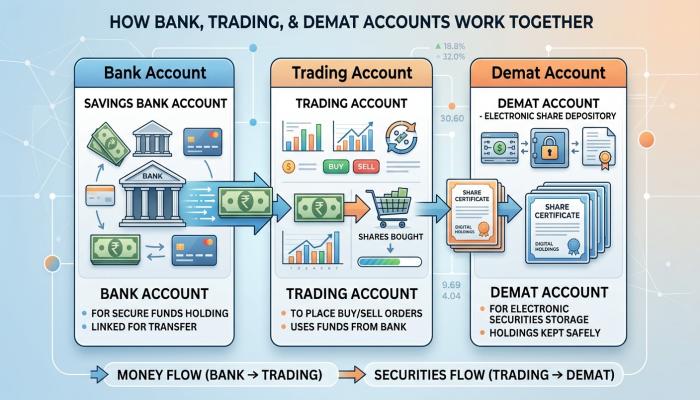
Most retail traders do not directly connect themselves to a stock exchange.
Instead, they normally use a registered intermediary.
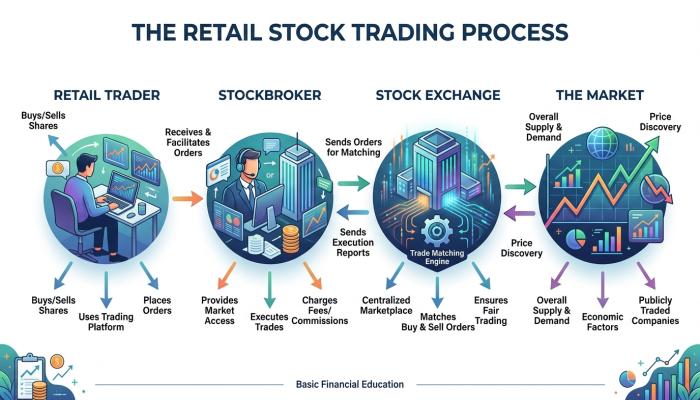
A typical process looks like this:
Trader → Broker → Stock Exchange → Market
You place an order through the broker’s website or app. The broker’s systems route the order to the relevant exchange.
After the trade is executed, the transaction goes through the applicable clearing and settlement process.
Indian investors should also understand the role of regulators and market infrastructure. The Securities and Exchange Board of India (SEBI) regulates the securities market, while exchanges such as NSE and BSE provide trading platforms for listed securities.
Before opening an account, I would always check whether the intermediary is properly registered and whether the services being offered match what you actually need.
Trading Companies vs Stockbrokers
These terms are sometimes used interchangeably, but they are not always the same.
Stockbrokers
A stockbroker generally provides investors with access to financial markets.
Typical services may include:
- Trading accounts
- Demat accounts
- Mobile and web platforms
- Order placement
- Market information
- Research
- Customer support
The exact services depend on the broker.
Proprietary Trading Companies
A proprietary, or “prop”, trading firm trades using its own capital rather than simply executing retail investors’ orders.
The business model can therefore be very different from a normal retail brokerage.
Some firms may also offer trading programs or other arrangements for traders. Before paying any fee, read the terms carefully and understand exactly how the arrangement works.
Trading Technology Companies
Some businesses mainly provide software, charting tools, analytics, APIs, or other technology.
They may not be your stockbroker at all.
This is why checking the company’s actual role is important.
What Should You Check Before Choosing a Trading Company?
There is no single trading company that is suitable for every trader.
Your needs should decide what matters most.
1. Regulatory Registration
This should be one of your first checks.
If a company claims to provide regulated brokerage services in India, verify its registration and relevant details through official sources.
Do not depend only on advertisements, social media posts, or screenshots.
A professional-looking website does not automatically mean that a company is regulated.
2. Brokerage and Other Charges
Do not look only at the headline brokerage figure.
Your actual trading cost can include several components.
Depending on the transaction, you may encounter:
- Brokerage
- Securities Transaction Tax (STT)
- Exchange transaction charges
- GST
- SEBI-related charges
- Stamp duty
- Depository charges
- Other applicable fees
Charges can also differ according to the product and order type.
For example, the cost structure for equity delivery can be different from intraday trading or derivatives.
Always check the latest official pricing page before making a decision.
Also Read: Demat Account: Meaning, How It Works, Charges and What Indian Investors Should Know
3. Trading Platform
A trading platform should be easy for you to understand and use.
Look at factors such as:
- Order placement
- Charts
- Watchlists
- Market depth
- Order history
- Portfolio information
- Fund management
- Stability during market hours
A platform with many features is not necessarily better for a beginner.
Simple and reliable can be more useful than complicated.
4. Customer Support
Problems can happen.
An order may not appear correctly. Funds may take time to reflect. You may have questions about account verification or another service.
Before choosing a company, check what support channels are available.
Also look at recent user feedback, but treat online reviews carefully. Individual complaints do not automatically prove that a company has a systemic problem.
Paper Trading: A Useful Way to Practise
If you are completely new to trading, paper trading can be useful.
Paper trading means practising trades without using real money.
Instead of actually buying or selling an asset, you record what you would have done and track the result.
For example, imagine a stock is trading at ₹500.
You decide that you would buy 10 shares.
Your hypothetical position would be:
₹500 × 10 = ₹5,000
If the price later reaches ₹520, your theoretical gain would be ₹200 before considering any real-world trading costs.
No actual ₹5,000 has been invested in this example.
The purpose is to practise decision-making.
Is Paper Trading Free?
Many paper trading tools offer free features, but not every platform works in the same way.
Some may provide a free practice account. Others may have paid features, delayed market data, or limitations.
So when searching for paper trading free options, check exactly what is included.
A free account may not provide every feature available in a paid plan.
You should also check whether the platform uses live, delayed, or simulated data.
Paper Trading Website India: What Should You Look For?
If you are searching for a paper trading website India, do not choose one simply because it says “free demo.”
Check these things first:
Realistic Order Simulation
A good simulator should allow you to practise common order types and understand how positions behave.
Trading Costs
Some simulations ignore brokerage, taxes, slippage, or other costs.
That can make your results look better than they might be in real trading.
Market Data
Find out whether prices are real-time or delayed.
This can make a major difference when practising short-term strategies.
Record Keeping
A useful simulator should help you track your trades.
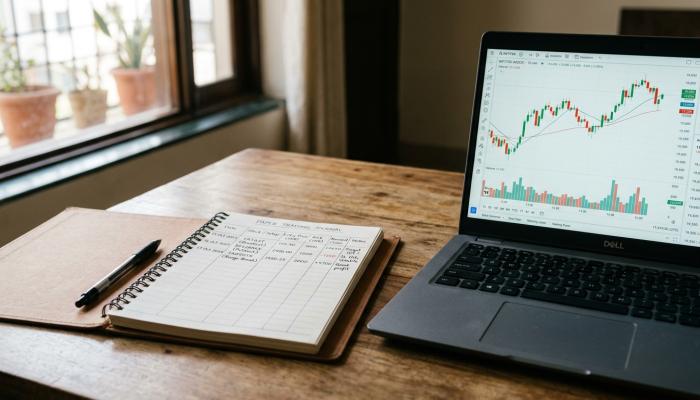
Record:
- Entry price
- Exit price
- Quantity
- Reason for entering
- Reason for exiting
- Result
- Mistake made
This turns paper trading into a learning exercise rather than a game.
Paper Trading Free Demo: Is It Enough to Learn Trading?
A paper trading–free demo can help you understand the mechanics of trading.
But it has an important limitation.
There is no real financial loss when a simulated trade goes wrong.
That changes your emotions.
When real money is involved, traders can experience fear, greed, hesitation, and overconfidence.
A paper account cannot fully reproduce those emotions.
Therefore, a profitable paper-trading record does not guarantee that the same strategy will make money with real capital.
Advantages of Paper Trading
Paper trading can be especially useful for beginners.
You Can Learn Without Losing Money
You can make mistakes without putting your savings at immediate risk.
You Can Test a Trading Plan
Suppose your plan says you will enter only after a specific technical setup appears.
You can track whether that rule actually works over many trades.
You Can Learn Order Types
It gives you a practical way to understand concepts such as:
- Market orders
- Limit orders
- Stop-loss orders
- Position size
- Entry and exit
- Risk-to-reward ratio
You Can Identify Bad Habits
Keeping a trading journal can reveal repeated mistakes.
For example, you may discover that you frequently enter trades because of sudden price movements rather than following your plan.
Limitations of Paper Trading
Paper trading is helpful, but it is not perfect.
Slippage May Be Missing
In real markets, the price you expect may not always be the price at which your order is executed.
Emotions Are Different
Real money creates psychological pressure.
Liquidity May Be Different
A simulated order may appear easy to execute, while a real order in a less liquid security may behave differently.
Results Can Be Misleading
A trader might take excessive risk in a simulation because there is no real loss.
That can create unrealistic confidence.
Common Mistakes Beginners Make
I often see beginners focus too much on finding a company or platform and not enough on learning risk management.
Here are some common mistakes to avoid.
Chasing Guaranteed Returns
There is no legitimate trading system that can guarantee profits.
Be particularly careful with anyone promising fixed daily or monthly returns.
Ignoring Total Costs
A strategy that appears profitable before charges may become much less attractive after all applicable costs.
Trading Too Frequently
More trades do not automatically mean more profit.
Frequent trading can increase costs and emotional pressure.
Using Too Much Leverage
Leverage allows you to control a larger position with less initial capital, but it can also increase losses quickly.
Beginners should understand the risks before using it.
Copying Someone Else’s Trades
A trade that suits one person’s capital, experience, and risk tolerance may not suit another person.
Learning the reasoning behind a strategy is more useful than blindly copying entries.
How I Would Evaluate a Trading Platform
As an analyst, I would not judge a platform only by its advertising.
I would look at five basic areas:
- Regulation and credibility
- Total trading costs
- Platform usability
- Order execution and reliability
- Customer support and account services
Then I would compare those points with my actual trading requirements.
For a long-term investor, some advanced trading tools may not matter much.
For an active trader, platform stability, order functionality, charts, and costs may matter much more.
Who Can Benefit From Paper Trading?
Paper trading may be useful for:
- Complete beginners
- Students learning market basics
- Traders testing a new strategy
- Investors learning order types
- People returning to markets after a long break
It can also be useful when you want to practise without immediately putting money into a strategy you do not understand.
Who Should Not Rely Only on Paper Trading?
Paper trading should not be treated as proof that you are ready for real-money trading.
If your results come mainly from taking unrealistic risks, the practice may teach you the wrong habits.
Before moving to real trading, understand:
- Your maximum acceptable loss
- Position sizing
- Trading costs
- Stop-loss limitations
- Market volatility
- Leverage risks
- Tax and regulatory considerations
Most importantly, never use money that you cannot afford to lose.
Practical Checklist Before Using a Trading Company
Before opening an account or paying for a trading service, I recommend checking:
- Is the company and relevant intermediary properly registered?
- What products does it actually offer?
- What are the complete charges?
- Is there a Demat account requirement?
- How easy is the trading platform to use?
- What order types are available?
- What customer support options are provided?
- Are there any platform or account limitations?
- What are the withdrawal and fund-transfer rules?
- Are the terms and conditions clear?
- If it offers paper trading, is the market data live or delayed?
- Does the paper-trading system include realistic costs?
Taking a few minutes to check these points can help you avoid many unnecessary problems.
FAQ
What are trading companies?
Trading companies can refer to businesses that provide brokerage, trading technology, professional trading, research, or other market-related services. The exact meaning depends on the company’s business model.
Is paper trading free in India?
Some paper trading services offer free plans or demo features. However, features and data availability vary, so check the current terms before using one.
Is paper trading the same as real trading?
No. Paper trading simulates trading without real financial risk. Real trading involves actual money, execution conditions, charges, and emotional pressure.
Can paper trading guarantee trading success?
No. Paper trading can help you practise, but it cannot guarantee future profits.
How should beginners choose a trading company?
Beginners should first check regulatory status, total costs, platform usability, available products, support, and the company’s terms. They should also understand the risks before depositing real money.
Conclusion
Trading companies can provide very different services, so it is important to understand what you are actually choosing.
If you are looking for a broker, focus on regulation, costs, platform quality, support, and the products you plan to use.
If you are still learning, paper trading can be a useful starting point. A free demo can help you understand order placement, risk management, and trading discipline without immediately risking real money.
But remember that simulated results are not the same as real trading results.
Take time to learn the market, compare the complete costs, verify important information from official sources, and avoid anyone promising guaranteed returns.
Disclaimer: This article is for educational and informational purposes only. It is not financial advice, investment advice, or a recommendation to use any particular trading company or financial product. Regulations, charges, products, and platform features can change, so verify the latest information from official sources before making financial decisions.