If you are new to the Indian commodities market, you may have questions like: What is commodity trading? How does it work? What is the commodity trading time in India? Which commodity trading platform or app can you use? And how is commodity trading treated in income tax?
Commodity trading means buying and selling commodity contracts to benefit from price movements. In India, commodity derivatives are mainly traded on recognised exchanges, with MCX being a major platform for commodities.
However, commodity trading is different from buying physical gold, silver, crude oil, or agricultural products. You are generally trading contracts whose value changes with the price of the underlying commodity.
In this guide, I will explain commodity trading in simple language, including its meaning, trading hours, platforms, apps, costs, risks, taxation basics, and practical points beginners should understand.
Table of Contents
What Is Commodity Trading?
Commodity trading is the buying and selling of commodity-based contracts through an exchange.
A commodity can be a physical product such as:
- Gold
- Silver
- Crude oil
- Natural gas
- Copper
- Aluminium
- Zinc
- Lead
- Agricultural commodities
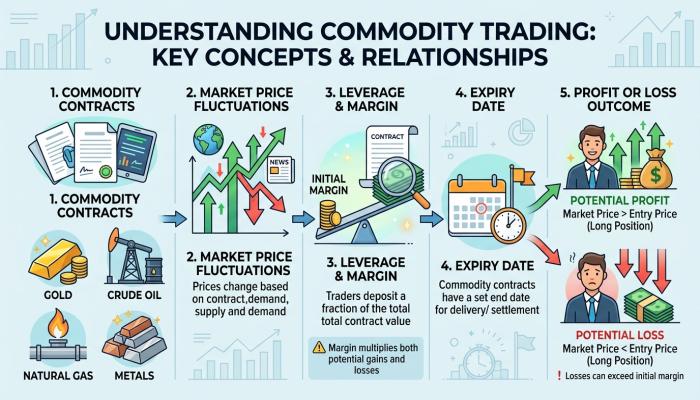
In the derivatives market, traders normally do not take physical delivery of these products when they trade short-term contracts. Instead, they trade contracts linked to the price of the commodity.
For example, suppose gold prices are moving higher. A trader may take a position in a gold futures contract based on their market view.
If the price moves in the expected direction, the position can generate a profit. If the price moves against the position, the trader can lose money.
This is why commodity trading should not be treated as easy or risk-free.
Commodity Trading Meaning in Simple Words
The simplest commodity trading meaning is:
Buying or selling commodity contracts to take advantage of changes in commodity prices.
There are two common ways to participate:
Futures Trading
A futures contract is an agreement based on a particular commodity and expiry.
You do not necessarily pay the full contract value upfront. Instead, the broker normally requires an applicable margin.
This makes futures trading capital-efficient, but it also increases risk because a relatively small price movement can have a meaningful effect on your trading capital.
Options Trading
Commodity options give traders the right, but not the obligation, to buy or sell an underlying contract at a specified price, depending on the option type.
Options have additional concepts such as premium, strike price, expiry, time value and volatility.
Beginners should understand these concepts before trading commodity options.
How Does Commodity Trading Work in India?
The basic process is similar to other forms of exchange-based trading.
First, you need an account with a broker that offers commodity derivatives.
You then select the commodity contract you want to study.
For example, you may see contracts linked to gold, silver, crude oil or natural gas.
Before placing an order, check:
- Contract name
- Contract size
- Expiry date
- Current price
- Required margin
- Tick size
- Brokerage
- Exchange and regulatory charges
- Applicable taxes
You can then place a buy or sell order through the broker’s trading platform.
The profit or loss depends on how the contract price changes after you enter the position.
Commodity Trading Time in India
Commodity trading hours are different from equity market timings.
On Indian commodity derivatives exchanges, trading generally extends beyond the regular equity market session. The exact timings can vary depending on the commodity segment, exchange rules and changes introduced by the exchange.
For this reason, do not rely on an old trading-hours article or screenshot.
If you are planning a trade, check the latest trading schedule on the relevant exchange or your broker’s platform.
This is particularly important for international-linked commodities such as crude oil, natural gas, gold and silver because global markets can influence their prices.
Why Commodity Trading Hours Matter
Commodity prices can react to events happening outside normal Indian equity market hours.
Examples include:
- US economic data
- Global crude oil developments
- Central-bank decisions
- Currency movements
- Geopolitical events
- International commodity supply changes
A trader who holds a position during these periods should understand that prices can move quickly.
What Is a Commodity Trading Platform?
A commodity trading platform is the website or software through which you monitor commodity prices and place trades.
Depending on the broker, the platform may provide:
- Live market prices
- Charts
- Order placement
- Position tracking
- Margin information
- Market depth
- Technical indicators
- Contract information
- Profit and loss tracking
The exact features vary from one broker to another.
A platform with many features is not automatically suitable for every trader. For a beginner, reliability, clear order information and easy position monitoring can be more useful than having dozens of complicated tools.
Commodity Trading App: What Should You Check?
Many brokers now provide mobile apps for commodity trading.
Before using a commodity trading app, I would suggest checking a few practical points.
1. Order Placement
Make sure you can easily understand whether you are placing a buy or sell order.
Also check the order type before submitting it.
2. Margin Information
The app should make it reasonably clear how much margin is required for the position.
Remember that margin is not the same as your maximum possible loss.
3. Charts and Market Data
Good charts can help you study price movements.
However, indicators should not be treated as guaranteed prediction tools.
4. Position Monitoring
You should be able to quickly see:
- Open positions
- Average price
- Current price
- Unrealised profit or loss
- Required margin
- Available funds
5. Stability
A technical problem at an important time can be frustrating.
Before depending heavily on a mobile app, understand how you can manage your position if the app or internet connection becomes temporarily unavailable.
Benefits of Commodity Trading
Commodity trading can offer several useful features, but these benefits also come with risks.
Diversification
Commodities can behave differently from individual stocks.
For some investors, exposure to commodities can therefore be part of a broader portfolio strategy.
However, diversification does not remove market risk.
Extended Trading Hours
Commodity markets generally provide longer trading sessions than the normal Indian equity cash market.
This can be useful for traders who want to monitor global market developments.
Different Types of Commodities
Traders can study different markets instead of focusing only on shares.
For example, precious metals, energy products and industrial metals can respond to different economic factors.
Leverage Through Margin
Futures trading allows traders to control a contract by depositing margin rather than paying the full contract value upfront.
This can make trading capital-efficient.
But there is an important warning here: leverage can increase losses just as it can increase gains.
Risks and Disadvantages of Commodity Trading
This is the section beginners should pay close attention to.
High Volatility
Commodity prices can move sharply within a short period.
Crude oil and natural gas, for example, can react strongly to international developments.
Leverage Risk
A small price movement can have a relatively large impact on your account because futures contracts have a specified contract value.
Using too much leverage can quickly create losses.
Global Market Influence
Many commodities are influenced by international prices.
Events outside India can therefore affect your position.
Expiry Risk
Commodity derivatives have expiry dates.
You should know when your contract expires and understand the broker’s rules for handling positions near expiry.
Slippage
The price you see on the screen may not always be the exact price at which your order gets executed, especially during fast-moving markets.
Emotional Trading
After a loss, some traders increase their position to recover the money quickly.
This can make the situation worse.
A trading plan should include a clear risk limit before entering a position.
Also Read: MCX Share Price: Current Price, History, Targets, Tips and Corporate Actions
What Charges Apply to Commodity Trading?
Commodity trading does not involve only brokerage.
Depending on the transaction, you may encounter costs such as:
- Brokerage
- Exchange transaction charges
- GST
- Securities-related statutory charges where applicable
- Stamp duty
- SEBI-related charges
- Commodity-specific taxes or levies where applicable
The exact amount depends on the broker, exchange, product and current rules.
Brokerage plans can also change.
So, before opening or using a trading account, check the broker’s latest official tariff and applicable exchange charges rather than relying on an old blog post.
Commodity Trading and Income Tax in India
One important question is commodity trading treatment in income tax.
Tax treatment depends on the type of commodity transaction and the applicable tax rules.
Exchange-traded commodity futures may generally be treated differently from speculative transactions, depending on the nature of the transaction and the relevant provisions of the Income-tax Act.
Your final tax treatment can depend on factors such as:
- The type of contract
- Whether the transaction is on a recognised exchange
- The nature of your trading activity
- Whether you are treating trading as a business
- Your overall income and tax situation
- The applicable tax rules for the relevant financial year
Do not simply copy the tax treatment from another trader.
If your commodity trading activity is significant or complicated, it is sensible to discuss the records and tax treatment with a qualified tax professional.
Also remember that tax rules can change. Always check the latest official tax information for the financial year in question.
How Beginners Can Approach Commodity Trading
If you are new to this market, I would not start by looking for a quick profit.
Start by learning how the contract works.
Understand the contract size first.
For example, a commodity may have a much larger exposure than its displayed per-unit price suggests.
Then learn how a one-point price movement affects your position.
Start With One Commodity
Instead of following ten commodities at once, choose one or two markets to study.
Observe how they react to:
- Global news
- Currency movements
- Economic data
- Supply and demand
- Interest rates
- Market sentiment
This can help you understand the behaviour of the market.
Know Your Maximum Risk
Before entering a trade, decide how much money you are willing to risk.
Do not calculate risk only from the amount of margin required.
A low margin requirement does not mean the trade is low-risk.
Avoid Random Tips
Commodity markets can move quickly.
Following messages from social media groups or anonymous tip providers without understanding the trade can be dangerous.
Learn the reason behind a trade instead of simply copying an entry price.
Who May Find Commodity Trading Useful?
Commodity derivatives may interest people who:
- Want to learn commodity markets
- Understand futures and options
- Can handle significant price movements
- Want exposure to commodity-related markets
- Are willing to study risk and contract specifications
It may not be suitable for someone who expects quick and guaranteed returns.
It may also be unsuitable for a beginner who does not understand margin, expiry and position sizing.
Important Things to Check Before Trading
Before placing your first commodity order, check these points:
- Is the commodity contract suitable for your trading plan?
- What is the contract size?
- What is the expiry date?
- How much margin is required?
- What happens if the market moves sharply against you?
- What are the total trading costs?
- What are the exchange trading hours?
- Is the broker authorised to offer the relevant commodity segment?
- Do you understand the order type?
- Do you have a clear risk-management plan?
These basic checks can prevent many avoidable mistakes.
Commodity Trading vs Stock Trading
Commodity trading and stock trading are not the same.
With stocks, you can buy shares and potentially hold them for years.
Commodity derivatives are contracts with specific terms and expiry.
Commodity prices are also strongly influenced by global supply, demand and international markets.
Stocks, meanwhile, are influenced by company earnings, business performance, sector conditions and broader market factors.
Neither market should be considered automatically safer.
The right choice depends on your knowledge, risk tolerance, financial situation and trading objective.
Common Beginner Mistakes
Some mistakes appear again and again.
Trading Without Understanding Contract Size
A trader may look only at the commodity’s quoted price.
But the actual position exposure depends on the contract specification.
Using Excessive Margin
Having more buying power does not mean you should use all of it.
Ignoring Expiry
Every derivative trader should know the contract expiry and settlement rules.
Holding a Losing Trade Without a Plan
Hoping that the market will come back is not a risk-management strategy.
Trading Because of News
News can cause sudden price movements.
By the time a headline reaches social media, the market may already have reacted.
Final Thoughts
Commodity trading can be an interesting part of the Indian derivatives market, but it is not a simple shortcut to making money.
Before trading, understand the commodity, contract size, expiry, margin, trading hours and total costs.
Pay particular attention to risk because leverage can make both profits and losses larger.
If you are comparing commodity trading platforms or commodity trading apps, look beyond brokerage advertisements. Check the complete pricing, platform reliability, order tools, margin information and customer support arrangements.
Most importantly, keep your expectations realistic.
Learn first. Trade small if you eventually decide to trade. And never risk money that you cannot afford to lose.
FAQ
What is commodity trading?
Commodity trading means buying and selling commodity-based contracts through an exchange to take advantage of changes in commodity prices. Common examples include gold, silver, crude oil and natural gas.
What is the commodity trading time in India?
Commodity derivatives generally trade for longer hours than the regular equity cash market. Exact timings depend on the exchange and commodity contract, so check the latest exchange schedule before trading.
Which commodities can be traded in India?
Depending on the exchange and available contracts, traders may find commodities such as gold, silver, crude oil, natural gas and base metals. Contract availability can change.
Is commodity trading risky?
Yes. Commodity trading can involve significant risk because prices can move quickly and derivatives can involve margin and leverage. Losses can be larger than a beginner expects if risk is not controlled.
How is commodity trading treated in income tax?
The tax treatment depends on the type of transaction, exchange, nature of trading activity and applicable tax rules. Traders should check the current rules for the relevant financial year and seek professional tax advice when needed.
Conclusion
Commodity trading gives Indian traders access to markets such as precious metals, energy and industrial commodities.
But understanding the market is more important than simply opening a commodity trading app.
Before placing an order, learn the contract specifications, trading hours, margin requirements, charges, expiry rules and risks.
There is no guaranteed-profit strategy in commodity trading. A disciplined approach to risk is far more important than trying to predict every price movement.
Disclaimer
This article is for educational and informational purposes only. It is not financial, investment, trading or tax advice. Commodity derivatives involve substantial risk, and losses are possible. Trading hours, charges, regulations and tax rules may change, so verify the latest information with the relevant exchange, broker and official authorities before taking any action.