If you are searching for day trading for beginners, the first thing to understand is simple: day trading is not a quick-money method.
In day trading, you buy and sell a stock or other market instrument within the same trading day. The goal is to benefit from short-term price movements rather than holding the position for several days or years.
For beginners in India, the difficult part is not opening a trading account. It is managing risk, controlling emotions, understanding orders, and following a clear trading plan.
I am Shipon, and in this guide I will explain day trading in simple language. We will cover how it works, what beginners need, basic strategies, costs, common mistakes, and practical day trading tips and tricks.
Table of Contents
What Is Day Trading?
Day trading means opening and closing a trading position during the same market session.
For example, suppose you buy 100 shares of a company at ₹500 in the morning and sell them at ₹505 later that day.
Your gross price difference is:
₹505 − ₹500 = ₹5 per share
For 100 shares, that is ₹500 before trading costs and taxes.
The opposite can also happen. If the price falls to ₹495 and you exit, the loss would be ₹500 before costs.
This is why day trading requires both a trading plan and risk control.
Day trading is different from investing.
An investor may hold a stock for months or years. A day trader usually looks at shorter price movements and normally does not intend to carry an intraday position overnight.
Day Trading for Beginners in India: How Does It Work?
For day trading for beginners India, you generally need a trading and demat account with a properly registered broker.
You then use the broker’s trading platform to:
- Select a stock or market instrument.
- Study its price movement.
- Decide where to enter.
- Decide where to exit if the trade goes against you.
- Place the order.
- Monitor the position.
- Close the position according to your plan.
For the Indian equity market, NSE’s regular equity trading session currently runs from 9:15 AM to 3:30 PM, apart from weekends and exchange-declared holidays. There is also a pre-open session before regular trading. Always check the exchange calendar for holidays and special sessions.
The exact order types, margin rules, charges, and intraday product features can differ between brokers and can change over time.
So I recommend checking the broker’s latest pricing and product information before placing a trade.
Also Read: Trading Signals: How They Work, Types, Risks, and What Indian Traders Should Know
What Do Beginners Need Before Starting?
You do not need a large collection of indicators.
You need a few basic things first.
1. A Proper Trading Account
Choose a broker that is properly registered and clearly shows its charges and terms.
Do not choose a broker only because someone on social media says it is cheap or profitable.
SEBI also advises investors not to deal with unregistered brokers or intermediaries.
2. Basic Market Knowledge
Before risking real money, understand:
- Candlestick charts
- Market orders
- Limit orders
- Stop-loss orders
- Support and resistance
- Volume
- Risk-reward ratio
- Position sizing
- Brokerage and other trading costs
3. A Trading Plan
A simple plan should answer:
- What will I trade?
- What setup am I looking for?
- Where will I enter?
- Where will I exit if I am wrong?
- Where will I book profit?
- How much money am I willing to lose on one trade?
- When will I stop trading for the day?
Without these answers, trading can quickly become emotional.
A Simple Day Trading Strategy for Beginners
There is no single strategy that works in every market.
However, beginners can start by learning a simple price-action approach.
Step 1: Find a Liquid Stock
Liquidity means there are enough buyers and sellers for orders to be executed more easily.
Beginners should generally study actively traded stocks rather than extremely illiquid stocks.
Step 2: Identify the Trend
Look at the chart and ask:
Is the price generally moving upward, downward, or sideways?
A simple moving average can help you understand the broader short-term direction, but it should not be treated as a guaranteed signal.
Step 3: Mark Support and Resistance
Support is a price area where buying interest has appeared before.
Resistance is an area where selling pressure has appeared before.
These are zones, not exact magic numbers.
Step 4: Wait for Confirmation
Do not enter simply because a stock has reached support or resistance.
Wait for some evidence from price and volume.
For example, a trader may look for a breakout followed by strong trading activity.
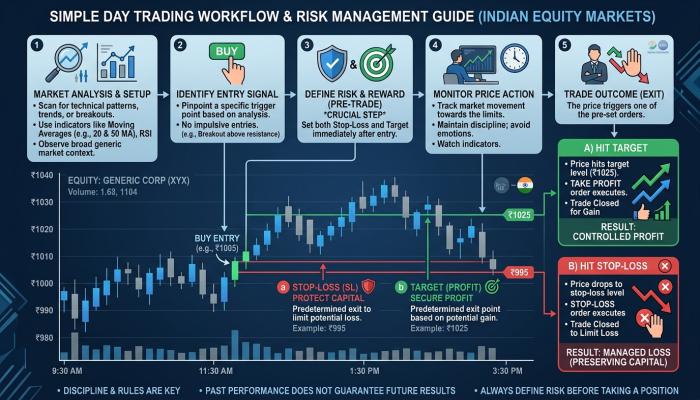
Step 5: Decide Your Stop-Loss Before Entering
A stop-loss is an order or planned exit level used to limit the loss if the trade moves against you.
For example:
Entry = ₹500
Stop-loss = ₹495
Risk = ₹5 per share
If you plan to trade 100 shares, the planned price risk is ₹500 before costs and any execution difference.
The important point is that position size should be based on your risk, not simply on how much money your broker allows you to trade.
What Is Position Sizing?
Position sizing means deciding how many shares you should trade.
This is one of the most important concepts for beginners.
Suppose you decide that the maximum amount you are willing to risk on a trade is ₹500.
Your entry price is ₹500.
Your stop-loss is ₹495.
Your risk per share is ₹5.
So:
₹500 ÷ ₹5 = 100 shares
This is only an educational example. Your actual risk limit should depend on your financial situation and trading plan.
The calculation also does not guarantee that the final loss will exactly equal the planned amount because execution can differ from the intended price.
Day Trading Tips and Tricks for Beginners
The word “tricks” can sometimes make trading sound easy.
It is not.
The most useful day trading tips are usually basic risk-management habits.
Trade Less, Not More
More trades do not automatically mean more opportunities.
If the market is unclear, staying out can be a valid decision.
Avoid Revenge Trading
Suppose you lose ₹1,000.
You then take another trade simply because you want to recover the ₹1,000.
This is revenge trading.
It can turn one bad trade into several bad trades.
Keep a Trading Journal
After each trade, record:
- Stock
- Entry price
- Exit price
- Stop-loss
- Reason for entry
- Reason for exit
- Profit or loss
- What you learned
After 20 or 30 trades, you may start seeing repeated mistakes in your own behaviour.
Do Not Follow Random Tips
A message saying “buy this stock now” is not a trading strategy.
SEBI specifically warns investors against relying on hot tips and advises them to avoid unregistered intermediaries.
Do Not Increase Your Risk After a Loss
A common beginner mistake is doubling the position after losing money.
This can make a small loss much larger.
Learn One Setup First
You do not need ten indicators.
Learn one simple setup properly.
Understand when it works, when it fails, and when you should avoid it.
Can Beginners Learn Day Trading for Free?
Yes.
There are many ways to study day trading for beginners free.
You can learn basic concepts through:
- Exchange education material
- SEBI investor education resources
- Broker educational material
- Charting practice
- Trading books
- Free market lectures
- Paper trading or simulated practice
You can also search for day trading for beginners free online courses and educational resources.
But free does not always mean good.
Check who created the material and whether the information is current.
Be especially careful with courses that promise fixed daily income or guaranteed returns.
Paper Trading Before Using Real Money
Paper trading means practising trades without using real money.
It can help beginners understand:
- How orders work
- How charts move
- How a strategy behaves
- How quickly prices can change
- How to record trades
However, paper trading has one major limitation.
There is no real financial loss.
Your emotions can be very different when actual money is involved.
So paper trading can be useful for learning, but it does not prove that you will make money in live trading.
How Much Money Do You Need for Day Trading?
There is no single amount that is suitable for every beginner.
Your broker may allow different levels of margin or intraday buying power depending on the product and current rules.
But the important question is not:
“How much can I trade?”
A better question is:
“How much can I afford to lose without affecting my essential finances?”
Do not borrow money just to increase your trading size.
SEBI’s investor guidance also says investors should not borrow money for investment and should understand intermediary charges and terms before dealing with them.
What Are the Costs of Day Trading?
A profitable-looking trade can become less profitable after costs.
Depending on the transaction, you may encounter costs such as:
- Brokerage
- Securities Transaction Tax (STT)
- Exchange transaction charges
- GST
- SEBI-related charges
- Stamp duty
- Other applicable statutory charges
The exact cost depends on the trade, segment, broker, and prevailing rules.
Brokerage plans can also change.
So before trading, check your broker’s latest brokerage calculator, pricing page, and contract note rather than relying on an old article or social media post.
The Biggest Problem: Losses
This is something I believe every beginner should understand before opening a live trade.
Day trading is risky.
SEBI’s study published in July 2024 found that 7 out of 10 individual traders in the equity cash intraday segment made losses during the study period.
That does not mean every beginner will lose money.
It means beginners should not approach day trading as easy income.
The risk is even more serious in derivatives. SEBI’s earlier research found that more than 9 out of 10 individual traders in equity F&O incurred losses during FY22–FY24.
SEBI has also published newer FY25–FY26 research on individual traders in equity derivatives, showing that this remains an important area of investor risk.
For a beginner, this is one reason I would focus first on learning market basics and risk management instead of immediately moving into complex leveraged products.
Common Day Trading Mistakes
Trading Without a Stop-Loss
A trader enters because the stock looks strong.
Then the price falls.
Instead of accepting a small loss, the trader waits and hopes.
The loss keeps growing.
Using Too Much Leverage
Leverage can increase your exposure.
It can also increase losses.
Do not confuse buying power with money you can safely afford to lose.
Trading Every Day
You do not have to trade every market session.
Some days simply do not offer a setup that matches your strategy.
Using Too Many Indicators
Five indicators showing five different signals can create confusion.
Start with simple tools and understand them properly.
Ignoring Trading Costs
If you make many small trades, costs can become important.
Always evaluate your results after applicable charges.
Trading Based on Emotions
Fear, greed, anger, and excitement can affect decision-making.
A written plan can help reduce impulsive decisions.
Is Day Trading Suitable for Everyone?
No.
Day trading may not be suitable if:
- You need the money for daily expenses.
- You cannot accept short-term losses.
- You have no time to monitor trades.
- You are looking for guaranteed income.
- You tend to make emotional decisions.
- You want to recover previous losses quickly.
- You are uncomfortable with financial risk.
It may be more appropriate to first learn and practise rather than immediately trading with meaningful amounts of money.
A Simple Beginner Routine
If I were creating a basic learning routine for someone starting from zero, I would keep it simple.
Before Market Open
Check the major market news and identify stocks you want to study.
Do not create a list of 30 stocks.
Start with a small watchlist.
During the Session
Wait for your setup.
Do not enter just because the market is moving.
Before every trade, know:
Entry → Stop-loss → Target → Position size
After the Session
Record your trades.
Ask:
- Did I follow my plan?
- Did I enter too early?
- Did I move my stop-loss?
- Did I overtrade?
- Did I follow a tip?
- Was the loss caused by my strategy or by breaking my own rules?
This review can be more useful than simply looking at your daily profit or loss.
Final Thoughts on Day Trading for Beginners
Day trading for beginners should start with education, not profit expectations.
Learn how the market works.
Understand orders.
Learn support and resistance.
Practise reading charts.
Understand trading costs.
Most importantly, learn how to control risk.
Do not believe anyone who says day trading is an easy way to make fixed daily income. There are no guaranteed profits in the stock market.
As Shipon, my view is simple: survival and discipline should come before trying to make money quickly.
If you can learn to protect your trading capital and follow a consistent process, you will at least be approaching the market in a more sensible way.
FAQ
Is day trading good for beginners?
Day trading can be learned by beginners, but it is risky. Beginners should first understand market basics, practise, and learn risk management before using significant real money.
Can I learn day trading for free?
Yes. You can learn the basics from free educational resources, exchange material, investor education websites, books, and market practice. Always check whether the information is current.
How much money do I need to start day trading in India?
There is no universal amount. Your required capital depends on the instrument, broker, position size, and risk level. Do not trade with money needed for essential expenses.
Which indicator is best for day trading?
There is no universally best indicator. Beginners can start with simple tools such as price action, volume, support and resistance, and a moving average.
Can day trading provide daily income?
There is no reliable or guaranteed daily income from day trading. Market conditions change, and losses are possible. SEBI research shows that many individual intraday traders lose money.
Conclusion
Day trading looks simple because a trade can take only a few minutes or hours.
The reality is different.
Successful trading requires preparation, risk control, discipline, and continuous learning. For beginners, the first goal should not be making large profits. It should be understanding the market and avoiding large, unnecessary losses.
Start slowly. Practise. Keep records. Avoid random tips and unrealistic profit promises.
The stock market rewards discipline, but it does not guarantee rewards for anyone.
Disclaimer
This article is for educational and informational purposes only. It is not financial advice or a recommendation to buy or sell any security. Trading involves the risk of loss. Brokerage, taxes, margin rules, market timings, and regulations can change, so check the latest information from your broker, NSE/BSE, and SEBI before trading.