If you have searched for trading signals, you have probably seen messages such as “Buy now,” “Sell near this level,” or “EUR/USD entry at this price.” Trading signals are widely used in stock, forex, and other online trading markets.
But a signal is not a guaranteed prediction. It is simply information that suggests a possible trading opportunity based on a particular method or analysis.
As a trader and technical analyst, I believe the important question is not just where to find signals. You should also understand how signals are created, what they contain, how reliable they may be, and what risks are involved.
This guide explains trading signals in simple language, including forex trading signals, stock trading signals, colour trading signals, free trading signals, and signals promoted for platforms such as Quotex.
Table of Contents
What Are Trading Signals?
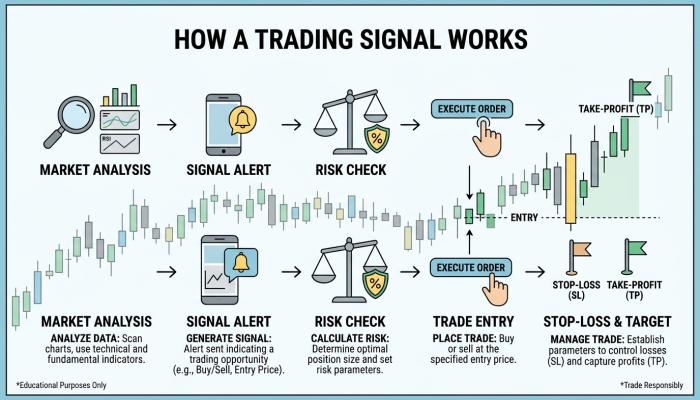
A trading signal is an alert or suggestion that points to a possible market trade.
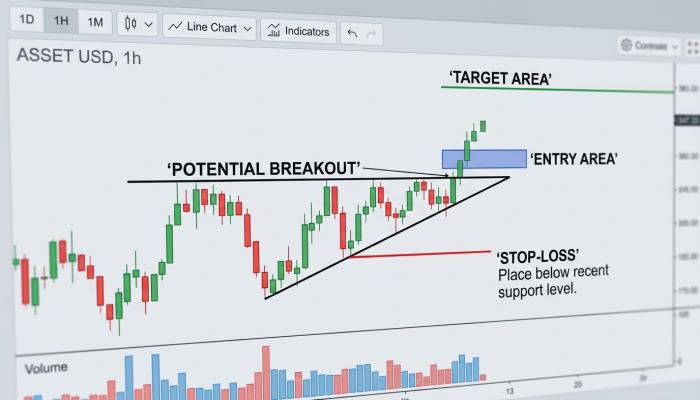
A signal may include:
- The asset or currency pair
- Possible entry price
- Buy or sell direction
- Stop-loss level
- Target or exit level
- Time frame
- Reason for the signal
For example, a stock signal might look like:
Stock: XYZ
Possible entry: ₹500
Stop-loss: ₹485
Target: ₹530
Time frame: Short term
This does not mean the stock will definitely reach ₹530.
Markets can move differently from the expectation behind the signal.
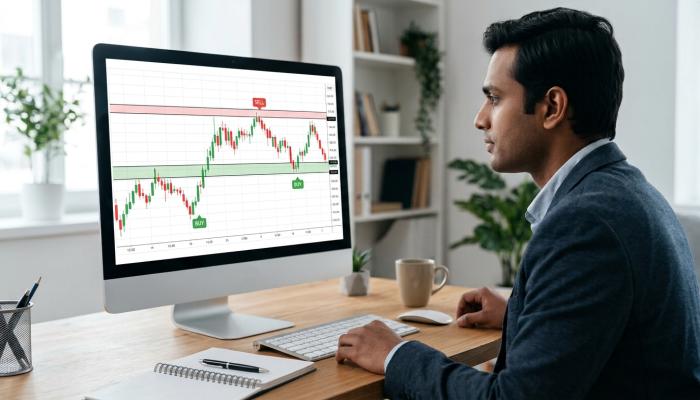
Trading signals can be generated manually by analysts or automatically using technical indicators, algorithms, or trading software.
How Do Trading Signals Work?
Most signals are based on a set of rules.
For example, a technical system may monitor:
- Price movement
- Moving averages
- RSI
- MACD
- Support and resistance
- Trading volume
- Breakouts
- Candlestick patterns
- Market trends
Suppose a stock moves above an important resistance level while volume increases. A signal system may identify this as a possible bullish setup.
A different system may produce a sell signal when price falls below a moving average.
The important point is that different systems can produce different signals at the same time.
That is why traders should understand the method behind a signal instead of blindly following the alert.
Also Read: Stock Analysis: Simple Guide for Indian Investors 2026
Main Types of Trading Signals
There is no single type of trading signal. The signal depends on the market and strategy being used.
Stock Trading Signals
Stock trading signals are designed for shares listed on stock exchanges.
They may identify:
- Possible breakout levels
- Trend changes
- Support and resistance
- Momentum
- Volume-based setups
- Short-term trading opportunities
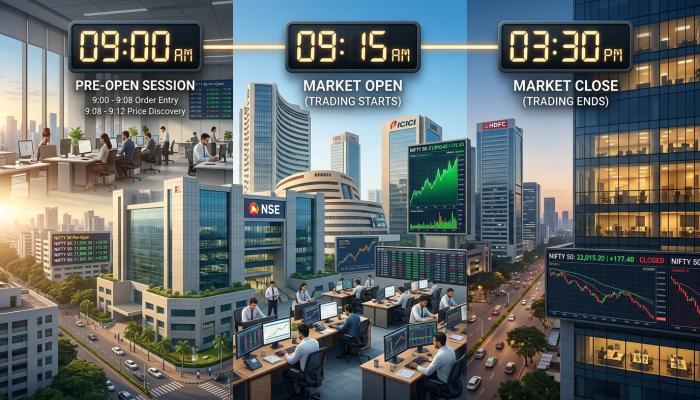
Indian traders may encounter signals for NSE or BSE-listed stocks.
However, a signal should not replace your own research. Corporate announcements, earnings, news, liquidity, and broader market conditions can affect a stock quickly.
Forex Trading Signals
Forex trading signals are alerts for currency pairs such as EUR/USD, GBP/USD, or USD/JPY.
A forex signal can contain an entry level, stop-loss and one or more possible targets.
Forex markets can react strongly to:
- Interest-rate decisions
- Inflation data
- Employment reports
- Central-bank announcements
- Geopolitical events
Therefore, even a technically attractive setup can fail when important economic news changes market conditions.
Indian readers should also understand the applicable Indian rules before trading currency derivatives or using overseas forex platforms.
Free Trading Signals
You can find many free trading signals on websites, messaging channels, social media, and trading communities.
The main advantage is obvious: there is no direct subscription cost.
But free does not automatically mean reliable.
Some free signal providers may use the signals to promote paid services, affiliate links, courses, or trading platforms.
Before trusting a free signal source, check:
- Who is providing it?
- Is the method explained?
- Are losses shown as well as successful trades?
- Is there a verifiable long-term record?
- Are risks clearly explained?
- Are they making unrealistic profit claims?
A screenshot showing several winning trades is not enough to prove a strategy works consistently.
What Are Colour Trading Signals?
The term colour trading signals is commonly used in some online trading and short-duration prediction-style platforms.
Signals may be represented by colours such as green, red, or other indicators. The colour is generally presented as an indication of a possible outcome or direction.
The problem is that the meaning of a colour depends entirely on the platform or system.
Do not assume that a green colour always means “buy” or that a red colour always means “sell.” Check the rules of the specific service.
More importantly, if a platform is asking you to predict short-term outcomes, you should understand the difference between genuine market trading and prediction-style products. Very short-duration products can carry substantial risk.
Do not treat a colour signal as a guaranteed result.
What About Quotex Trading Signals?
You may also come across searches for Quotex trading signals.
These are usually signals or alerts promoted for users of the Quotex platform. However, the existence of a signal does not establish that it is accurate or that following it will make money.
Before using any platform or signal service, Indian users should check:
- Whether the service is legally available to them
- The regulatory status of the provider
- Withdrawal and account terms
- Fees and other costs
- The type of financial product involved
- Whether the service is appropriate under applicable Indian regulations
Do not deposit money simply because a social-media channel claims that its signals are highly accurate.
What Is a Pro Trading Signals Script?
You may see the phrase pro trading signals script when searching for indicators, trading tools, or scripts for charting platforms.
A script can automatically identify conditions according to programmed rules.
For example, a script might show an alert when:
- Two moving averages cross
- RSI enters a particular range
- Price breaks resistance
- A candlestick pattern appears
- Volume increases above a set level
A script is only as good as its rules and data.
It cannot know every future market event.
A common mistake is to assume that an indicator that looks excellent on historical charts will automatically perform well in live markets. This is not necessarily true.
Are Trading Signals Accurate?
There is no universal accuracy rate for trading signals.
A signal provider may advertise a high success rate, but you should ask how that number was calculated.
For example:
- Was it based on real trades?
- Was it based on historical testing?
- Were losing trades included?
- Were brokerage and other costs included?
- Was the market condition similar to today’s market?
- Was the result independently verified?
A strategy can have many winning trades and still lose money if its losing trades are much larger.
For this reason, win rate alone is not enough.
Risk-to-reward ratio, drawdown, transaction costs, and the number of trades all matter.
Benefits of Using Trading Signals
Trading signals can be useful in certain situations.
They Can Save Research Time
A signal can quickly highlight a stock or currency pair that meets certain conditions.
This can help traders create a watchlist.
They Can Provide a Trading Framework
A good signal may include entry, stop-loss and target levels.
This gives the trader a clear framework for evaluating the setup.
They Can Help Beginners Learn
Instead of simply copying signals, beginners can study why a particular signal was generated.
For example, they can compare the alert with the chart and identify the support, resistance, trend, or indicator that caused the signal.
This can turn signals into a learning tool.
Limitations and Risks
Trading signals also have important disadvantages.
Signals Can Be Wrong
No technical system can predict every market move.
A breakout can fail. A trend can reverse. Unexpected news can move the market rapidly.
Signals Can Arrive Late
In fast markets, there may be a delay between the signal being generated and the trader receiving or acting on it.
The original entry price may no longer be available.
Costs Can Reduce Results
Brokerage, exchange charges, taxes, spreads, slippage, and other costs can affect actual returns.
A signal that looks profitable before costs may not be equally attractive after costs.
Blind Following Is Risky
The biggest problem is blindly following alerts.
If you do not understand why a signal exists, it becomes difficult to judge whether the setup still makes sense when the market changes.
How I Would Evaluate a Trading Signal
I would not judge a signal simply by looking at yesterday’s successful calls.
I would check the process behind it.
1. Understand the Method
Find out whether the signals are based on technical indicators, price action, fundamental data, algorithms, or another method.
2. Check Historical Evidence
If performance data is provided, look for a meaningful sample rather than a handful of winning trades.
3. Look for Losing Trades
A provider that only displays winners is giving you incomplete information.
Losses are a normal part of trading.
4. Check Risk Management
A signal without a sensible stop-loss or risk plan may be difficult to use safely.
Never risk money you cannot afford to lose.
5. Watch for Unrealistic Claims
Be careful with phrases such as:
- Guaranteed profit
- No-loss strategy
- 99% accuracy
- Fixed daily income
- Guaranteed returns
These claims should be treated as major warning signs.
Common Problems With Signal Services
The Signal Arrives Too Late
This can happen because of internet delays, notification delays, or fast price movement.
Practical approach: Compare the quoted entry price with the current market price before taking any action.
The Price Has Already Moved
Sometimes a signal is published at ₹500 but the market is already at ₹510 when you see it.
Do not assume that the original setup remains valid.
Too Many Signals
Some services send a large number of alerts every day.
This can encourage overtrading.
A trader does not need to participate in every market move.
Conflicting Signals
One indicator may suggest buying while another suggests selling.
This is normal because different systems use different rules.
Instead of searching for a signal that agrees with you, understand the complete setup.
How Beginners Can Use Signals More Carefully
If you are new to trading, avoid making signals your only decision-making tool.
A better learning process is:
Signal → Check chart → Understand reason → Check risk → Decide whether the setup fits your plan
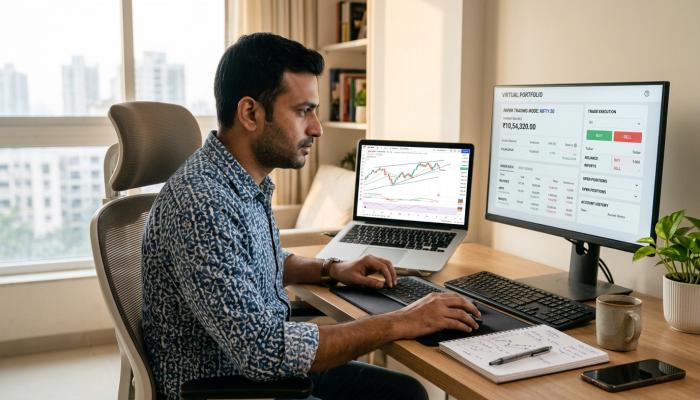
You can also use paper trading or a trading simulator where appropriate to understand how a signal behaves without immediately risking real money.
Keep a trading journal.
Record:
- Date
- Asset
- Signal
- Entry
- Stop-loss
- Target
- Result
- Reason for taking the trade
After enough observations, you can evaluate whether the signal method actually fits your trading style.
Trading Signals vs Your Own Analysis
Trading signals and personal analysis do not have to be opposites.
A trader can use a signal as a starting point and then perform independent analysis.
For example, a signal may identify a possible breakout. You can then check:
- Is the broader trend supportive?
- Is volume reasonable?
- Is there major resistance nearby?
- Is important news expected?
- Is the risk acceptable?
- Does the setup match your trading plan?
This approach is very different from blindly copying an alert.
Who May Find Trading Signals Useful?
Trading signals may be useful for traders who:
- Want help finding potential setups
- Are learning technical analysis
- Have limited time for market scanning
- Want alerts based on specific rules
- Are willing to verify signals independently
They may be less suitable for someone who expects signals to provide guaranteed income or wants to trade without learning basic risk management.
What Should You Check Before Paying for a Signal Service?
Before subscribing, check:
- The identity of the provider.
- How signals are generated.
- Complete performance records, if available.
- Whether losing trades are disclosed.
- Subscription and renewal charges.
- Refund conditions.
- Privacy and payment terms.
- Whether performance figures include trading costs.
- Applicable regulatory and legal considerations.
- Whether the service makes unrealistic claims.
Also check the latest information before paying. Pricing, features, regulations, and platform conditions can change.
A Simple Example
Imagine a signal says:
Possible entry: ₹1,000
Stop-loss: ₹970
Target: ₹1,060
The potential risk is ₹30 per share, while the potential target difference is ₹60.
That gives a potential risk-to-target relationship of 1:2.
But this does not mean the trader will earn ₹60.
The stock may hit ₹970 first. It may move sideways. It may never reach ₹1,060.
This simple example shows why a signal should be treated as a trading setup, not a promise.
Final Thoughts on Trading Signals
Trading signals can be useful when they are treated as research inputs rather than guaranteed instructions.
The quality of a signal depends on its method, data, risk management, market conditions, and execution. Even a well-designed system can produce losing trades.
For Indian traders, it is also important to check the legal and regulatory position of the market, broker, platform, or service before putting money into it.
My main suggestion is simple: learn the reason behind a signal before trusting the signal itself.
A good trader should know what can go wrong, how much can be lost, and when a setup is no longer valid.
FAQ
Are trading signals guaranteed to make money?
No. Trading signals are not guarantees. They are suggestions based on a particular analysis method, and every signal can fail.
Are free trading signals reliable?
Some may be useful, but free signals should not automatically be considered reliable. Check the provider, methodology, track record, risk management, and transparency before using them.
What are forex trading signals?
Forex trading signals are alerts suggesting possible trades in currency pairs. They may include an entry level, stop-loss, target, and trading direction.
Can beginners use trading signals?
Beginners can use them as learning and research tools. However, blindly copying signals without understanding risk management can be dangerous.
What should I check before using a signal service?
Check how the signals are generated, historical evidence, losing trades, risk controls, costs, renewal terms, provider identity, and applicable legal or regulatory requirements.
Conclusion
Trading signals can make market scanning easier, but they cannot remove trading risk.
Whether you are looking at stock trading signals, forex trading signals, free trading signals, or signals linked to online trading platforms, always do your own checks.
Do not judge a service only by screenshots of winning trades or impressive accuracy claims.
Learn the method. Check the risks. Consider costs. Start small if you decide to test a strategy, and never trade money you cannot afford to lose.
Disclaimer
This article is for educational and informational purposes only. It is not financial, investment, or trading advice. Market conditions, regulations, platform features, and charges can change. Always verify the latest information from relevant official sources and consider taking advice from a qualified financial professional before making investment decisions.