Intraday trading means buying and selling a financial instrument within the same trading day. The main aim is to take advantage of short-term price movements rather than holding a position for several days or years.
For Indian traders, intraday trading can look simple because trades are opened and closed on the same day. But in practice, it requires discipline, risk management, market knowledge, and a clear trading plan.
In this guide, I will explain what is intraday trading, how it works, the usual intraday trading time, charges you should understand, how traders select intraday trading stocks, and some practical intraday trading tips.
Table of Contents
What Is Intraday Trading?
Intraday trading is a form of short-term trading where a trader opens and closes a position during the same trading session.
For example, suppose a trader buys 100 shares of a company at ₹500 in the morning. If the price rises to ₹505, the trader may sell the shares on the same day.
The gross price difference would be:
₹505 − ₹500 = ₹5 per share
For 100 shares, that is ₹500 before brokerage, taxes, and other applicable costs.
The opposite can also happen. If the price falls, the trade can result in a loss.
The important point is that intraday trading does not automatically mean making quick money. Short-term price movements can go in either direction.
How Does Intraday Trading Work?
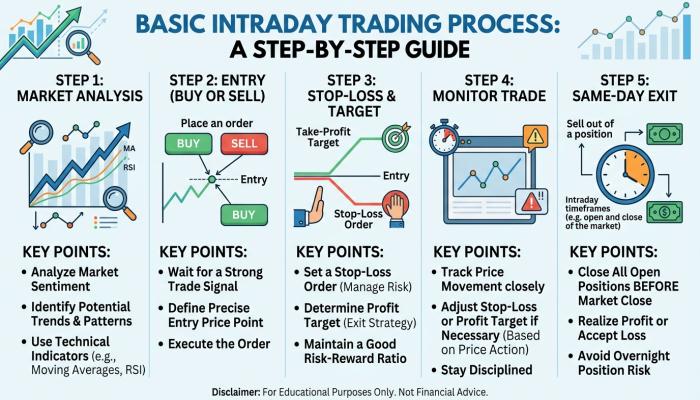
The basic process is fairly simple.
1. Choose a tradable instrument
A trader first selects a stock, index derivative, or another eligible instrument depending on the trading account and product.
2. Analyse the market
Traders may use price charts, volume, support and resistance, moving averages, market trends, and other technical indicators.
Technical analysis means studying price and market data to identify possible trading setups.
3. Enter the trade
The trader places an order based on the planned setup.
For example, a trader may plan to enter only if a stock moves above a particular resistance level.
4. Manage the position
After entering, the trader needs to manage both profit and risk.
A stop-loss order may be used to limit the loss if the market moves against the trade.
5. Exit before the trading session ends
Intraday positions are generally intended to be closed on the same trading day. However, the exact treatment of positions depends on the broker, product type, exchange rules, and order settings.
Always check your broker’s latest rules for intraday positions and auto square-off.
Intraday Trading Time in India
For equity trading on Indian exchanges, the normal market session for regular equity trading is generally 9:15 AM to 3:30 PM on trading days.
However, this does not mean every minute of the session is equally suitable for every trader.
The opening period can be highly active because overnight news and market orders are reflected in prices.
The middle part of the session can sometimes be quieter.
The final part of the session can again become active as traders adjust or close positions.
Market conditions can change quickly, so traders should not assume that a particular time will always produce better results.
Also remember that different market segments can have different trading schedules.
Before trading, check the latest exchange trading hours and your broker’s rules.
What Are Intraday Trading Stocks?
Intraday trading stocks are shares that traders choose for short-term buying and selling during a trading session.
There is no single list of stocks that will always be suitable for intraday trading.
Traders often look at factors such as:
- Trading volume
- Liquidity
- Bid-ask spread
- Price movement
- Volatility
- News or corporate events
- Overall market trend
Why liquidity matters
Liquidity means how easily a stock can be bought or sold without causing a large price change.
A liquid stock generally has more buyers and sellers.
This can make order execution easier compared with a stock where very few people are trading.
But liquidity does not remove market risk.
Why volatility matters
Volatility refers to how quickly and how much the price moves.
Higher volatility can create more trading opportunities, but it can also increase losses quickly.
A beginner should not select a stock only because it is moving sharply.
Intraday Trading Charges You Should Know
Intraday trading is not free.
The exact cost depends on your broker, exchange segment, order type, turnover, and applicable taxes and fees.
Common costs can include:
Brokerage
Some brokers offer low or zero brokerage under specific plans or products, while others charge according to their pricing structure.
Do not assume that “zero brokerage” means there are no trading costs.
STT
Securities Transaction Tax may apply according to the applicable rules.
The rate and applicability can change, so check the latest official information.
Exchange transaction charges
Stock exchanges levy transaction-related charges.
These are generally reflected in the contract note or trade statement.
GST
GST can apply to certain brokerage and transaction-related services.
Stamp duty
Stamp duty may also apply according to the applicable rules and transaction type.
SEBI and other regulatory charges
Regulatory and other statutory charges can also form part of the final cost.
Because charges and regulations can change, check your broker’s current pricing page and contract note before calculating your expected trading cost.
Also Read: Max Life Insurance: Policy Details, Login Process, and What You Should Know
Why Charges Matter in Intraday Trading
A common mistake is to focus only on the entry and exit price.
Suppose a trader makes several small trades during the day. Even if some trades are profitable, repeated transaction costs can reduce the overall result.
This is why I think traders should calculate the net result after charges, not just the gross price difference.
A simple calculation is:
Net result = Gross profit/loss − applicable trading costs
This gives a more realistic picture of the trade.
Important Intraday Trading Tips for Beginners
1. Have a trading plan
Do not enter a trade simply because a stock is moving.
Before entering, know:
- Why you are entering
- Where you will exit if wrong
- Where you may book profit
- How much you are willing to lose
- What will invalidate the trade
2. Use a stop-loss carefully
A stop-loss is an order or planned exit level intended to limit a loss.
It does not guarantee that you will exit at exactly the selected price. During fast markets or gaps, execution can differ.
Still, having a predefined risk level can help prevent one trade from becoming a very large loss.
3. Do not risk too much on one trade
Your trading capital should not be treated as money that must be recovered quickly.
If one losing trade creates a strong emotional reaction, the position size may be too large for your risk tolerance.
4. Avoid revenge trading
A losing trade can make traders want to immediately recover the money.
This often leads to taking another trade without a proper setup.
If you have reached your daily risk limit, stopping for the day can be a sensible decision.
5. Do not overuse leverage
Leverage allows traders to control a larger position with less upfront capital.
It can increase exposure to the market.
That means losses can also grow quickly.
Beginners should understand the full risk and cost of leveraged products before using them.
6. Keep a trading journal
Record important details such as:
- Entry price
- Exit price
- Position size
- Reason for entry
- Stop-loss
- Result
- Mistake made
- Market conditions
After several trades, this can help you identify repeated mistakes.
7. Start with one simple setup
Trying to use ten indicators at once can create confusion.
It can be better to understand one or two simple setups properly and learn when they fail.
Common Mistakes in Intraday Trading
Trading without a stop-loss
A trader may enter a position expecting a small profit but continue holding after the market moves against them.
The small planned loss can then become much larger.
Taking too many trades
More trades do not automatically mean more profits.
Overtrading can increase both emotional pressure and transaction costs.
Following social media tips blindly
Messages such as “sure-shot stock”, “guaranteed target”, or “100% profit” should be treated with caution.
Nobody can guarantee the short-term movement of a stock.
Ignoring news
Corporate announcements, economic data, global market movements, and unexpected events can affect prices quickly.
Technical analysis cannot predict every event.
Trading with borrowed money without understanding the risk
Using borrowed funds can increase financial pressure.
Intraday trading should not be treated as a quick solution for personal financial problems.
Is Intraday Trading Suitable for Everyone?
No.
Intraday trading may require regular market monitoring, quick decisions, emotional control, and a clear risk-management process.
It may not suit someone who:
- Cannot monitor positions during market hours
- Cannot accept short-term losses
- Is looking for guaranteed income
- Has no emergency savings
- Is trading only because of social media recommendations
- Finds market losses difficult to handle emotionally
For some people, longer-term investing may be more appropriate. The right approach depends on individual circumstances, goals, risk tolerance, and knowledge.
Intraday Trading vs Delivery Trading
The main difference is the holding period.
| Feature | Intraday Trading | Delivery/Long-Term Holding |
|---|---|---|
| Holding period | Usually same trading day | Days, months, or years |
| Main focus | Short-term price movement | Longer-term price movement |
| Monitoring | Often requires more attention | Usually less frequent |
| Short-term volatility | Very important | May be less important |
| Trading costs | Can add up with frequent trades | Usually lower frequency |
| Risk | Can be high | Depends on investment and holding period |
Neither approach is automatically better for everyone.
The important question is whether the method matches your goals, knowledge, and ability to manage risk.
What Should You Check Before Starting?
Before placing your first intraday trade, check these points:
- Understand how your broker’s intraday product works.
- Check the latest brokerage and statutory charges.
- Understand order types.
- Know the current market timings.
- Learn how stop-loss orders work.
- Understand leverage and margin requirements.
- Know the broker’s auto square-off policy.
- Start with a trading plan.
- Keep your position size under control.
- Maintain records of your trades.
It is also useful to understand the contract note you receive after trading. It shows important information about your transactions and charges.
A Simple Example of Intraday Risk Management
Suppose a trader has ₹50,000 as trading capital.
Instead of deciding position size first, the trader could first decide how much money they are prepared to lose if the setup fails.
For example, if the trader decides that the maximum planned loss for a particular trade is ₹500, the position size should be calculated around the distance between the entry and stop-loss.
This does not make the trade safe.
It simply gives the trader a predefined risk framework.
The actual loss can still differ because of slippage, fast price movements, execution conditions, or other factors.
Final Thoughts
Intraday trading is not simply about buying in the morning and selling at a higher price.
It is a skill-based activity that involves market analysis, order execution, risk management, trading costs, and emotional discipline.
The most important lesson I would give a new trader is to focus on risk first and profit second.
Understand the market, know your costs, use a clear plan, and avoid trades based only on excitement or fear of missing out.
There is no guaranteed intraday trading strategy. Even experienced traders have losing trades.
The goal should be to make decisions based on a repeatable process rather than trying to predict every market move.
FAQ
What is intraday trading?
Intraday trading means opening and closing a trade within the same trading day. The trader attempts to benefit from short-term price movements.
What is the intraday trading time in India?
For regular equity trading, the normal market session is generally from 9:15 AM to 3:30 PM on trading days. Different market segments can have different timings.
Which are the best intraday trading stocks?
There is no permanently “best” list. Traders commonly consider liquidity, volume, volatility, spread, and current market conditions when selecting stocks.
What are intraday trading charges?
Charges can include brokerage, STT, exchange transaction charges, GST, stamp duty, and regulatory charges. The exact amount depends on the broker and transaction.
Can beginners do intraday trading?
Beginners can learn intraday trading, but they should understand the risks before using real money. Starting with education, paper trading, small exposure, and strict risk management can help build experience.
Conclusion
Intraday trading offers a way to participate in short-term market movements, but it also carries significant risk.
Success is not guaranteed, and frequent trading can increase costs and losses.
Before starting, learn how orders work, understand intraday trading charges, check market timings, study risk management, and create a clear trading plan.
Most importantly, never trade with money you cannot afford to lose.
Disclaimer
This article is for educational and informational purposes only. It is not financial, investment, or trading advice. Market prices and trading rules can change. Check the latest information from your broker, the relevant stock exchange, SEBI, and other official sources before making any trading decision.