
If you have been searching for information on the Bajaj Finance share, you are probably trying to understand where the stock stands today, how it has moved over the years, and whether it deserves a place in your portfolio. I am Shipon, and in this post I will walk you through the Bajaj Finance share price journey, what moves it, and the practical things you should check before making any decision.
This is not a “buy” or “sell” recommendation. It is meant to help you understand the stock better so you can do your own research with more confidence.
Table of Contents
A Quick Introduction to Bajaj Finance
Bajaj Finance Limited is one of India’s largest non-banking financial companies (NBFCs). It is a subsidiary of Bajaj Finserv and is part of the larger Bajaj Group. The company started out in 1987 focused on financing two and three-wheelers, and over the years it has grown into a diversified lender offering consumer loans, personal loans, business loans, home loans, and more.
The stock trades on both the NSE (BAJFINANCE) and the BSE (500034). It is also part of major indices like the Nifty 50, which means a lot of index funds and mutual funds hold it automatically.
Bajaj Finance Share Price Today
As of late August 2026, Bajaj Finance share price on the NSE was trading around ₹1,083, with the BSE price close to ₹1,077. The stock had a 52-week high of about ₹1,176 and a 52-week low of around ₹788.
Because prices move every trading day, this number will already be different by the time you read this. Please check a live source like NSE, BSE, or your broker’s app for the Bajaj Finance share price today before making any decision.
A few numbers that are commonly tracked by investors:
- Market capitalisation: roughly ₹6.7 lakh crore, making it one of the largest NBFCs listed in India
- P/E ratio: in the mid-30s range, which is on the higher side compared to many traditional lenders
- P/B ratio: in the mid-single digits, again reflecting a premium valuation
These ratios change daily along with the price, so treat them as a general guide, not a fixed number.
Bajaj Finance Share Price History: The Split and Bonus Story
If you look at old news articles or charts and see Bajaj Finance trading at ₹7,000 or even ₹9,000, don’t be confused. This is one of the most important things to understand about the Bajaj Finance share price history.
In April 2025, the company’s board approved two corporate actions:
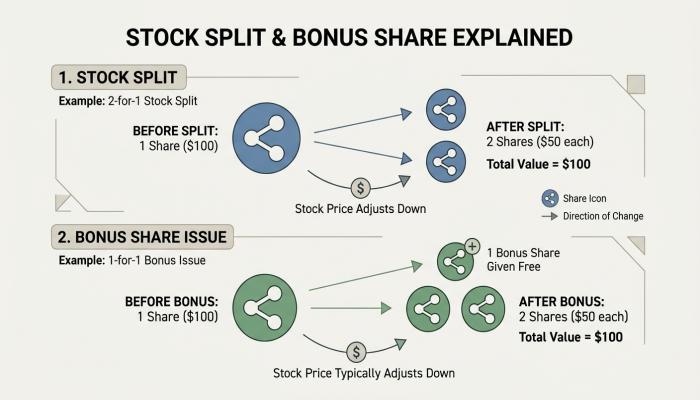
- A 1:2 stock split — each share with a face value of ₹2 was sub-divided into two shares of ₹1 face value each.
- A 4:1 bonus issue — for every one share held (after the split), shareholders received four additional bonus shares.
Put together, one original share effectively became ten shares. The record date for both actions was 16 June 2025.
This is why the share price, which was trading close to ₹9,300 before the record date, adjusted down to roughly ₹930 immediately after. This was purely a mathematical adjustment — the total value of your holding did not change on that day, only the number of shares and the price per share.
The company had last done a similar split and bonus back in 2016. The stated goal both times was to make the stock more affordable and improve liquidity for retail investors.
If you are comparing historical charts, always check whether the data source has adjusted old prices for this split and bonus. Some older articles and screenshots will still show the pre-adjustment price, which can be misleading if you don’t know the context.
Bajaj Finance Share Price on NSE vs BSE
You will often notice a small difference between the Bajaj Finance share price on NSE and its price on BSE. This is completely normal for actively traded, large-cap stocks. The difference is usually just a few rupees and is caused by slightly different order flow and timing between the two exchanges.
For most retail investors, it does not matter much which exchange you trade on, since brokers typically route your order to whichever exchange offers a better price at that moment (this is called “smart order routing” on some platforms). Do check with your broker to confirm how they handle this.
Recent Business Performance
Bajaj Finance’s stock price is closely tied to its quarterly results, since it is a lending business and profit growth, loan book expansion, and asset quality all matter a lot to investors.
In recent quarters, the company has reported strong year-on-year net profit growth, supported by continued growth in its loan book (assets under management, or AUM) and improving asset quality, with gross non-performing assets (NPAs) staying at relatively low levels compared to many peers in the NBFC space.
Brokerage firms regularly publish target prices based on these results. For example, some analysts have projected continued strong AUM growth into FY27. However, please remember that broker target prices are opinions, not guarantees. They can and do change with each quarterly result, and different brokerages often have very different views on the same stock.
Also Read: Inflation Rate in India: What It Means for Your Money and Investments (2026 Update)
What Drives the Bajaj Finance Share Price Target
If you are searching for the Bajaj Finance share price target, it helps to know what analysts typically look at:
- Loan book (AUM) growth rate — how fast the company is growing its lending business
- Net interest margins — the difference between what the company earns on loans and pays on borrowings
- Asset quality — gross and net NPA levels, and how well bad loans are being managed
- Return on assets (RoA) and return on equity (RoE) — profitability measures the company itself often guides on
- Regulatory environment — RBI rules for NBFCs can change and directly affect lending practices
- Overall market sentiment — NBFC stocks as a sector tend to move together during rate-cycle changes
Because these targets change frequently, I would suggest checking a recent, dated brokerage report rather than relying on any single number you find online, including in this article.
Benefits of Considering Bajaj Finance as an Investment
- Market leadership: It is one of the largest and most diversified NBFCs in India, with a presence across consumer durables, personal loans, business loans, and more.
- Strong brand backing: Being part of the Bajaj Group gives it a well-recognised brand name and management pedigree.
- Consistent growth track record: Historically, the company has shown strong loan book and profit growth over many years, though past performance never guarantees future results.
- Index inclusion: Being part of Nifty 50 means steady demand from index funds and institutional investors.
Limitations and Risks to Keep in Mind
- Premium valuation: The stock’s P/E ratio has historically traded higher than many other NBFCs and banks, which means the market has high growth expectations already priced in. Any slowdown can lead to sharper price corrections.
- NBFC-specific risks: Rising interest rates increase borrowing costs, which can pressure margins if not passed on to customers.
- Regulatory risk: RBI periodically tightens rules for NBFCs, including on unsecured lending, which can directly affect growth plans.
- Asset quality risk: Like any lender, a rise in loan defaults during an economic slowdown can hurt profits.
- Market-wide risk: Being a large-cap, high-beta stock, it can also fall sharply during broader market corrections, regardless of its own business performance.
Common Problems New Investors Face With This Stock
“The price looks too high to buy a full share.” Since the price is in the four-figure range, some new investors hesitate. Many brokers now allow you to buy in smaller lot sizes or through systematic investment plans (SIPs) into stocks, so check if your broker offers this if budget is a concern.
“Old charts and articles show a very different price.” As explained above, this is almost always because of the 2025 stock split and bonus issue. Always check whether the chart or data you are looking at is split-adjusted.
“I am confused about which target price to trust.” Different brokerages publish different targets based on their own assumptions. Instead of chasing a single number, it is more useful to read the reasoning behind the target — what growth rate or margin assumption they are using — and judge if that reasoning makes sense to you.
Who Might Find Bajaj Finance Shares Useful
Investors who are comfortable with:
- A long-term horizon, since NBFC stocks can be volatile in the short term
- Slightly higher valuations in exchange for a market-leading, well-managed business
- Doing periodic research to track quarterly results and RBI policy changes
Who May Want to Be Cautious
- Investors looking for very low-volatility, dividend-heavy stocks, since Bajaj Finance’s dividend yield is typically modest compared to its share price
- Investors who are not comfortable tracking NBFC sector news and RBI regulatory updates regularly
- Very short-term traders who are not comfortable with the stock’s historical price swings
Practical Tips Before You Invest
- Always check the live share price on NSE or BSE, or your broker’s app, right before placing an order — do not rely on numbers from articles like this one, including mine.
- Look at the latest quarterly results and investor presentation on the company’s own website for the most reliable, first-hand data.
- Compare at least two or three brokerage reports for share price targets, rather than relying on just one.
- Check the current brokerage charges, account maintenance charges, and other fees on your trading platform, since these can change over time.
- Understand your own risk appetite and investment horizon before deciding how much to allocate to any single stock.
FAQ
Q1. What caused the big drop in Bajaj Finance’s share price in June 2025? It was not a real drop in value. The company carried out a 1:2 stock split and a 4:1 bonus share issue, which together turned one share into ten. The price adjusted downward in proportion, but the total value of an existing shareholder’s holding was unaffected on that day.
Q2. Is Bajaj Finance share price the same on NSE and BSE? It is usually very close but not always exactly identical, due to normal differences in trading activity between the two exchanges.
Q3. How can I check the latest Bajaj Finance share price target? Look for recent, dated reports from registered brokerages or research houses. Since targets are revised after every quarterly result, always check the publication date.
Q4. Is Bajaj Finance a safe stock to invest in? No listed stock is completely “safe” — all equity investments carry risk, including the risk of losing money. Bajaj Finance is a well-established, large-cap NBFC, but its price can still be volatile, and its business is subject to interest rate and regulatory risks like any lender.
Q5. Where can I find accurate, updated charges for trading Bajaj Finance shares? Charges vary by broker and can change over time. Always check your specific broker’s latest charge list on their official website before trading.
Conclusion
Bajaj Finance is one of India’s best-known NBFC stocks, backed by a strong brand, a large loan book, and a long track record of growth. But like any stock, its price today reflects a mix of past performance and future expectations — and those expectations can change quickly with quarterly results, RBI policy, or broader market moves. If you are researching the Bajaj Finance share price history, current price, or price target, always cross-check with live, dated sources rather than relying on any single article, and take your own risk profile into account before investing.
Disclaimer
This article is for educational and informational purposes only and does not constitute financial or investment advice. Share prices, financial ratios, and brokerage views change frequently and may not reflect current market conditions at the time you are reading this. Please verify all figures from live, official sources such as NSE, BSE, or your broker’s platform, and consult a SEBI-registered financial advisor before making any investment decisions. Investments in equity markets are subject to market risk.